Global financial markets on April 22, 2026 are navigating a complex mix of geopolitical developments, heavy corporate earnings, and shifting commodity prices. The indefinite extension of the US-Iran ceasefire is the dominant macro theme driving cross-asset moves today, while investors simultaneously monitor a packed earnings calendar featuring Tesla, IBM, Boeing, and Texas Instruments.
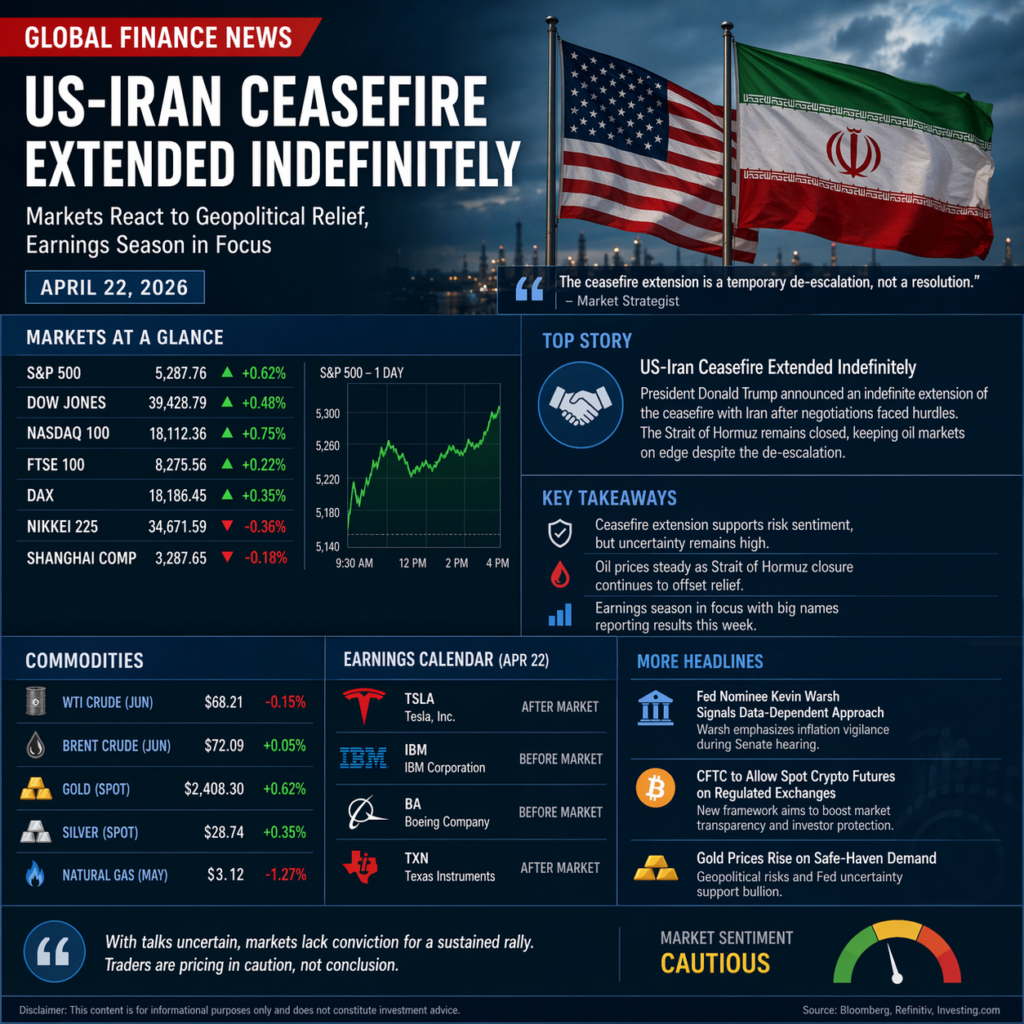
US-Iran Ceasefire Extended: What It Means for Markets
President Donald Trump announced an indefinite extension of the ceasefire with Iran on Tuesday evening, after reports emerged that Vice President JD Vance’s trip to join negotiations was paused due to a lack of commitment from Tehran. The extension was welcomed by equity markets but failed to produce a clear directional move in oil, given that the Strait of Hormuz remains closed and a comprehensive resolution appears distant.
Strategists note that with the outcome of talks still uncertain, markets lack the conviction needed for a sustained rally. The ceasefire extension is best understood as a temporary de-escalation rather than a resolution, and traders are pricing it accordingly.
Stock Markets: US Indices and Global Equities
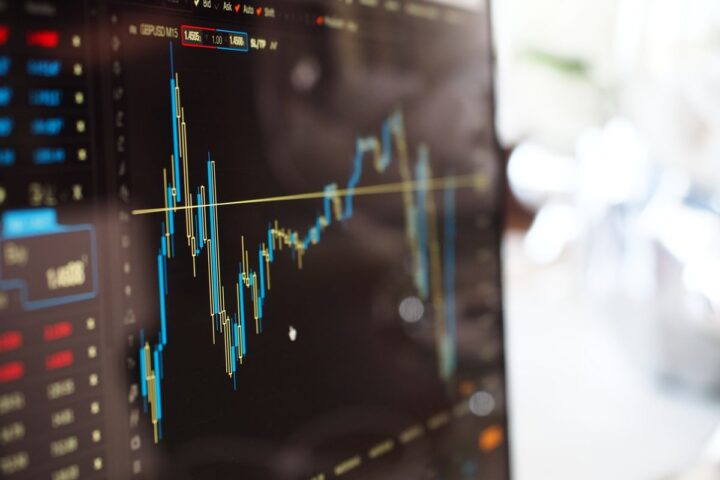
US equities closed Tuesday in negative territory ahead of the ceasefire announcement. The S&P 500 fell 0.63% to close at 7,064.01, the Nasdaq Composite declined 0.59% to 24,259.96, and the Dow Jones Industrial Average shed approximately 293 points to finish at 49,149.38. The sell-off was driven primarily by nervousness over the fate of the Iran peace talks before Trump’s announcement.
On Wednesday, European markets opened higher, tracking improved sentiment from US futures. Major indices including the DAX and FTSE 100 posted gains at the open. In Asia, South Korea’s Kospi hit a record high of 6,388.47, gaining 2.72%, led by Samsung Electronics and SK Hynix. China’s Shanghai Composite edged higher on domestic stimulus expectations, while Japan’s Nikkei 225 slipped on yen strength.
Earnings Season: What to Watch on April 22
April 22 is one of the heaviest single-day earnings releases of the season. Tesla reports after market close and is under particular scrutiny for production targets and profit margins amid intensifying global EV competition. Texas Instruments will provide critical insight into semiconductor demand trends. IBM, Boeing, AT&T, ServiceNow, Southwest Airlines, Lam Research, and Boston Scientific are also reporting today.
Key premarket moves heading into Wednesday’s session: GE Aerospace shares dropped roughly 6% after its CEO linked elevated energy prices to a potential pullback in airline maintenance work. Boston Scientific rose 1.2% on strong quarterly results. Adobe gained 2.8% after announcing new generative AI features across its product suite.
Oil Prices: Ceasefire Eases Supply Fear But Uncertainty Persists
Brent crude futures fell 0.2% to $98.27 per barrel on Wednesday, while US West Texas Intermediate dropped to $89.39 per barrel. Both benchmarks had gained approximately 3% in the prior session before the ceasefire extension was confirmed. The slight pullback reflects investor relief at the diplomatic progress, tempered by the reality that the Strait of Hormuz remains closed and no full agreement is in sight.
US crude inventories are projected to have drawn down by approximately 4.5 million barrels for the week ended April 17, a figure that could provide upward price support if confirmed by official data.
High crude prices continue to pressure central banks globally, reducing market expectations for near-term interest rate cuts. Several S&P 500 CEO earnings call transcripts this week cited energy costs as a primary business risk factor.
Gold and Commodities
Gold rebounded nearly 1% to approximately $4,768 per ounce on Wednesday, snapping a two-day losing streak. The move was supported by a softer dollar, continued geopolitical uncertainty, and safe-haven demand. Silver retreated 1.8% to around $77.80 per ounce during Asian trading despite the gold price recovery. Copper prices slid on profit-taking as investors rotated out of defensive positions following the temporary improvement in Middle East risk sentiment.
Federal Reserve: Warsh Hearing and Rate Cut Expectations
Fed Chair nominee Kevin Warsh appeared before the Senate Banking Committee on Tuesday in a closely watched confirmation hearing. Warsh denied making any promises to President Trump regarding future rate cuts and sought to establish his independence from White House influence. He backed the role of digital assets within the US financial system and outlined what observers described as a regime-change plan for the Federal Reserve.
Fed nominee Kevin Warsh’s confirmation hearing comes at a sensitive moment. Elevated energy costs are keeping inflation stickier than markets had hoped, and expectations for near-term rate cuts have been scaled back significantly across the US, UK, and European markets. UK inflation data expected this week is forecast to show marginal deceleration but remain above the Bank of England’s 2% target.
Global Trade: Critical Minerals and Supply Chain Talks
The US trade representative urged allied nations to pay a national security premium for critical minerals not sourced from China. The proposal involves a coalition of trading partners setting minimum pricing floors for non-Chinese sourced minerals, combined with steep tariffs on outside producers. Trade official Jamieson Greer argued that decades of prioritizing cost efficiency created dangerous Western dependence on Beijing for key industrial inputs.
Separately, the US Commerce Secretary initiated supply chain diversification talks with a major Asian partner, and the Trump administration is reportedly in early discussions over a currency swap line with the United Arab Emirates.
Crypto: Perpetual Futures, Kraken, and Bitcoin
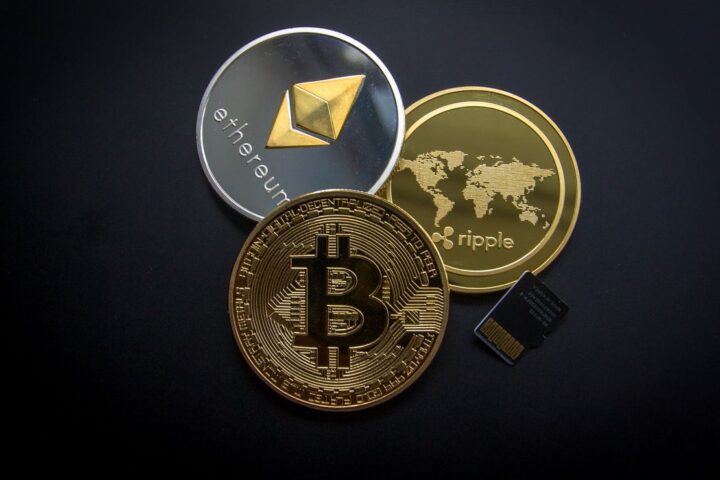
The US crypto market is preparing for a significant regulatory shift. Trump’s CFTC Chair nominee Michael Selig indicated the agency plans to fully approve perpetual crypto futures products, a high-leverage derivatives instrument popular offshore. In anticipation, Kraken acquired Bitnomial for up to $550 million to establish perpetual futures capability in the US market. Coinbase has been positioning itself with long-dated futures contracts designed to replicate perpetuals ahead of the rule change.
Bitcoin held near the $60,000 level overnight, consolidating despite minor outflows from US spot BTC exchange-traded funds. Cantor Fitzgerald raised its Coinbase price target to $250, maintaining an Overweight rating based on the company’s expanding product outlook.
Key Data Points Summary
S&P 500: 7,064.01 (down 0.63% Tuesday)
Dow Jones: 49,149.38 (down 293 points Tuesday)
Nasdaq: 24,259.96 (down 0.59% Tuesday)
Brent Crude: $98.27/barrel (down 0.2%)
WTI Crude: $89.39/barrel (down 0.3%)
Gold: $4,768/oz (up ~1%)
Silver: $77.80/oz (down 1.8%)
Bitcoin: ~$60,000 (stable)
Conclusion
April 22, 2026 presents investors with a classic risk-on, risk-off tension. The US-Iran ceasefire extension has temporarily improved sentiment, but the absence of a concrete resolution keeps uncertainty elevated across oil, currencies, and equities. A historically heavy earnings day adds company-level volatility on top of an already complex macro backdrop. Traders and long-term investors alike will be watching Tesla’s results after close as the day’s most consequential single data point.