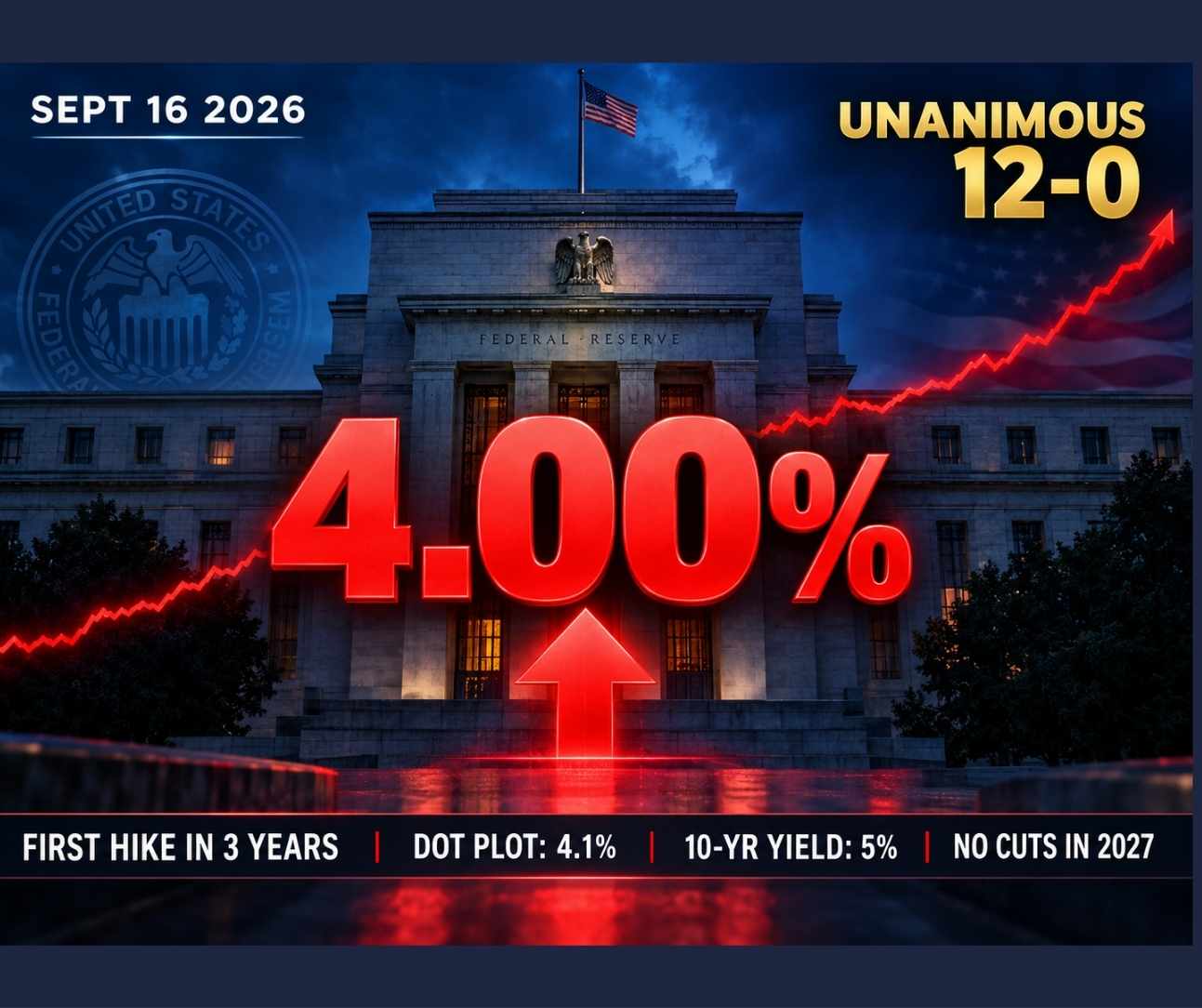
Markets today September 17 2026 are digesting the biggest Federal Reserve decision in three years. On Wednesday September 16, the FOMC raised the federal funds rate by 25 basis points to a target range of 3.75% to 4.00% — the first rate hike since 2023. The vote was 12 to 0. Unanimous. Not a single dissent. In July, that same committee split 9 to 3. Something changed. And what changed matters more than the quarter point itself.
Markets Today September 17 2026: The Fed Just Rewrote the Playbook
Markets today September 17 2026 are not reacting to a 25 basis point hike. Markets are reacting to everything around it. The dot plot. The language. The tone. The unanimous vote. Fed Chair Kevin Warsh did not sound like a central banker trying to thread a needle. He sounded like one who has decided the needle needs to move further and faster.
His exact words: “price stability is foundational to economic growth.” Three months ago, the Fed’s official stance was that policy was “modestly restrictive.” On Wednesday, Warsh said the committee had removed “a dose of accommodation.” That is not a small semantic shift. That is a signal that the current rate is still below where the Fed thinks it needs to be.
For anyone tracking markets today September 17 2026, the single most important number is not 4.00%. It is 3.2% — the new longer-run neutral rate estimate in the dot plot. That rose from its prior level, which means the Fed is telling you that the world has structurally changed. Higher oil. Persistent supply shocks. Geopolitical premium baked into every inflation print. The rate that used to be “neutral” is no longer enough to cool this economy.
What the Dot Plot Is Actually Saying
The dot plot delivered on markets today September 17 2026 is more hawkish than anything the Fed has published since the post-pandemic tightening cycle. Sixteen of eighteen FOMC participants expect at least one more rate hike before the end of 2026. Eight of those see an additional hike in 2027. The 2026 median dot moved to 4.1% from 3.8% — a 30 basis point revision in a single meeting. And the 2027 median shows zero cuts. None. The Fed is not signalling a pause and pivot. It is signalling a plateau at elevated levels.
The Fed’s 2026 core PCE inflation projection came in at 3.4% — still well above the 2% target. Former Fed Vice Chair Richard Clarida noted that this figure “may ultimately prove somewhat high, particularly given potential revisions to the underlying data.” But even with a downside revision, the trajectory does not get the Fed to 2% this year. The inflation fight is not over. The dot plot is priced accordingly.
Bond Market Reaction: Two Verdicts, Two Different Instruments
The bond market reaction on markets today September 17 2026 tells a precise story about what investors believe. The 2-year Treasury yield went into the Fed decision down 3 basis points on the day. It came out up 5 basis points. A 9 basis point swing in a matter of hours. The front end believed every word Warsh said. The 2-year is the instrument most sensitive to near-term Fed policy, and it repriced sharply higher — telling you that markets now take the next hike seriously.
The 10-year yield told a different story on markets today September 17 2026. It went into the meeting below 5%. It traded back through the 5% level and ended flat on the day. That divergence — front end rises, long end stays flat — reflects genuine market uncertainty about the growth outlook. The Fed may be able to hike again. Whether the economy can absorb it without breaking is a separate question. The flat long end is the bond market’s polite way of saying: we are not convinced this ends well.
What 12 to 0 Means and Why July’s 9 to 3 Matters
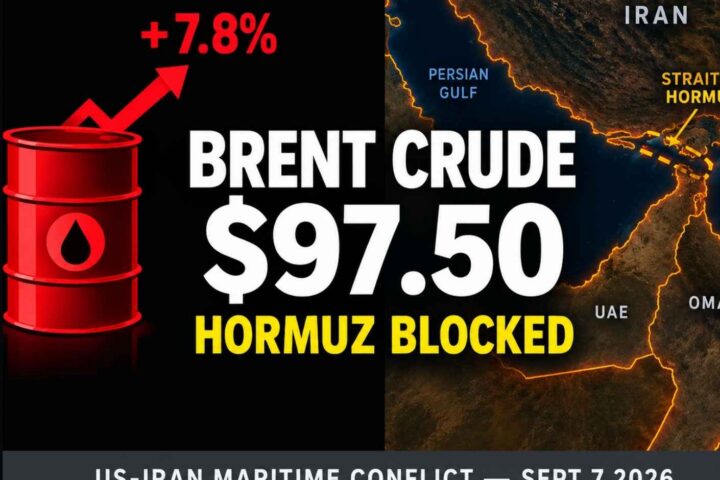
The vote on markets today September 17 2026 was 12 to 0. In July, the same committee voted 9 to 3 — three dissenters who wanted to hold. Every one of those three moved to the hiking camp between July and September. That shift was driven by three data inputs Warsh cited explicitly in his press conference: a strengthening economy, inflation running above the 2% target, and geopolitical “hot spots” — the Iran oil disruption and Saudi pipeline attack that pushed Brent crude above $108 and embedded an energy premium into every CPI print this quarter.
Unanimity matters in central banking. A split committee signals internal doubt, leaves room for a pivot, and gives markets an escape valve. A unanimous committee sends a different message entirely: we have all looked at the same data and we are all in agreement. No dissent. No hedge. The market response on markets today September 17 2026 reflects that clarity — uncertainty has collapsed in one direction. The next hike is not a question of if, it is a question of when.
What This Means for Equities, Bonds, and Bitcoin
On markets today September 17 2026, equity markets are processing a rate environment that looks nothing like 2024. The S&P 500 is under pressure from a simple arithmetic: when risk-free rates move to 4.00% and the dot plot points to 4.25% or higher, the multiple on future earnings compresses. Every analyst model that was built on a 3.5% terminal rate needs to be rebuilt. That is not a small adjustment.
For Bitcoin and crypto, markets today September 17 2026 are particularly challenging. Bitcoin has tracked closer to a long-duration growth asset than a safe-haven in this cycle. When real yields rise, crypto underperforms. With the 10-year at 5% and the Fed signalling no cuts through 2027, the bid underneath Bitcoin weakens. The $76,000 to $77,000 range that held through last week looks increasingly fragile if equities sell off sharply on the post-hike repricing.
For bond investors, the 2-year at current levels offers the most attractive risk-adjusted return in years. Cash earns 4.00% with zero duration risk. Short-duration bond funds outperform in an environment where the long end is flat and the front end is pricing further tightening. The classic 60/40 portfolio is not dead — but the 40 side needs to be positioned short, not long.
Key Data: The September 16 Fed Decision at a Glance
| Metric | Before | After |
|---|---|---|
| Fed Funds Rate | 3.50 to 3.75% | 3.75 to 4.00% |
| FOMC Vote | 9-3 (July) | 12-0 unanimous |
| 2026 Median Dot | 3.8% | 4.1% |
| Longer-Run Neutral Rate | Prior estimate | 3.2% (revised up) |
| Core PCE Projection 2026 | Prior estimate | 3.4% |
| 2027 Rate Cuts Priced | Some | Zero |
| 2-Year Treasury Yield | -3bp on day | +5bp after decision |
| 10-Year Treasury Yield | Below 5% | Back through 5%, flat |
Markets Today September 17 2026: What Comes Next
Markets today September 17 2026 are now pricing a 4.25% terminal rate as the base case, with the next decision on November 4-5. The Fed will receive two more CPI prints, one more jobs report, and a full quarter of earnings data before that meeting. If oil stays above $100 and core services inflation does not break lower, the November hike is close to a done deal. If oil drops sharply — either from a Hormuz resolution or demand destruction — the Fed has room to pause without losing credibility, given the unanimous September vote demonstrated its commitment.
For investors navigating markets today September 17 2026, the framework is clear: the Fed has told you exactly what it intends to do. Believe it. Position accordingly. Energy stocks retain their inflation hedge value. Short-duration fixed income earns real returns. High-multiple growth stocks face continued multiple compression. And any asset — crypto, speculative tech, long-duration bonds — that was priced on a rate cut cycle remains structurally challenged until the dot plot changes. Right now, it is not changing.
For the lead-up to this decision, read our Markets Today September 14 2026 preview and the Markets Today September 11 2026 CPI breakdown that set the stage for Wednesday’s unanimous vote.
Sources: Bloomberg: Fed Raises Rates as Warsh Contains Inflation | Federal Reserve: FOMC Statement September 16 2026 | WSJ: Fed Raises Rates for First Time in Three Years
Why did the Fed raise rates in September 2026?
The Federal Reserve raised rates by 25 basis points to 3.75-4.00% on September 16 2026 because inflation remains well above the 2% target, the economy is still strong with 162,000 August payrolls, and oil above $108 from Middle East supply disruptions is keeping price pressures elevated. The vote was unanimous 12-0.
What does the Fed dot plot show for 2026 and 2027?
The September 2026 dot plot shows 16 of 18 Fed officials expect at least one more rate hike before year end, taking the median 2026 target to 4.1%. For 2027, the median shows zero rate cuts — meaning the Fed intends to hold rates at elevated levels through next year. The longer-run neutral rate estimate was also revised up to 3.2%.
How did bond markets react to the Fed hike on September 16 2026?
The 2-year Treasury yield surged 9 basis points around the decision — down 3bp going in, up 5bp coming out — reflecting the front end pricing in the next hike. The 10-year yield traded back through 5% but ended the day flat, signalling market uncertainty about the growth outlook beyond the near-term tightening path.
What does the Fed hike mean for Bitcoin and stocks?
Higher rates compress equity multiples and weaken Bitcoin, which trades increasingly like a long-duration growth asset. With the Fed signalling no cuts through 2027 and the 10-year at 5%, speculative assets remain under structural pressure. Short-duration bonds and energy stocks are the better-positioned assets in the current rate regime.