Historic Milestone: China’s Trade Surplus Tops $1.08 Trillion
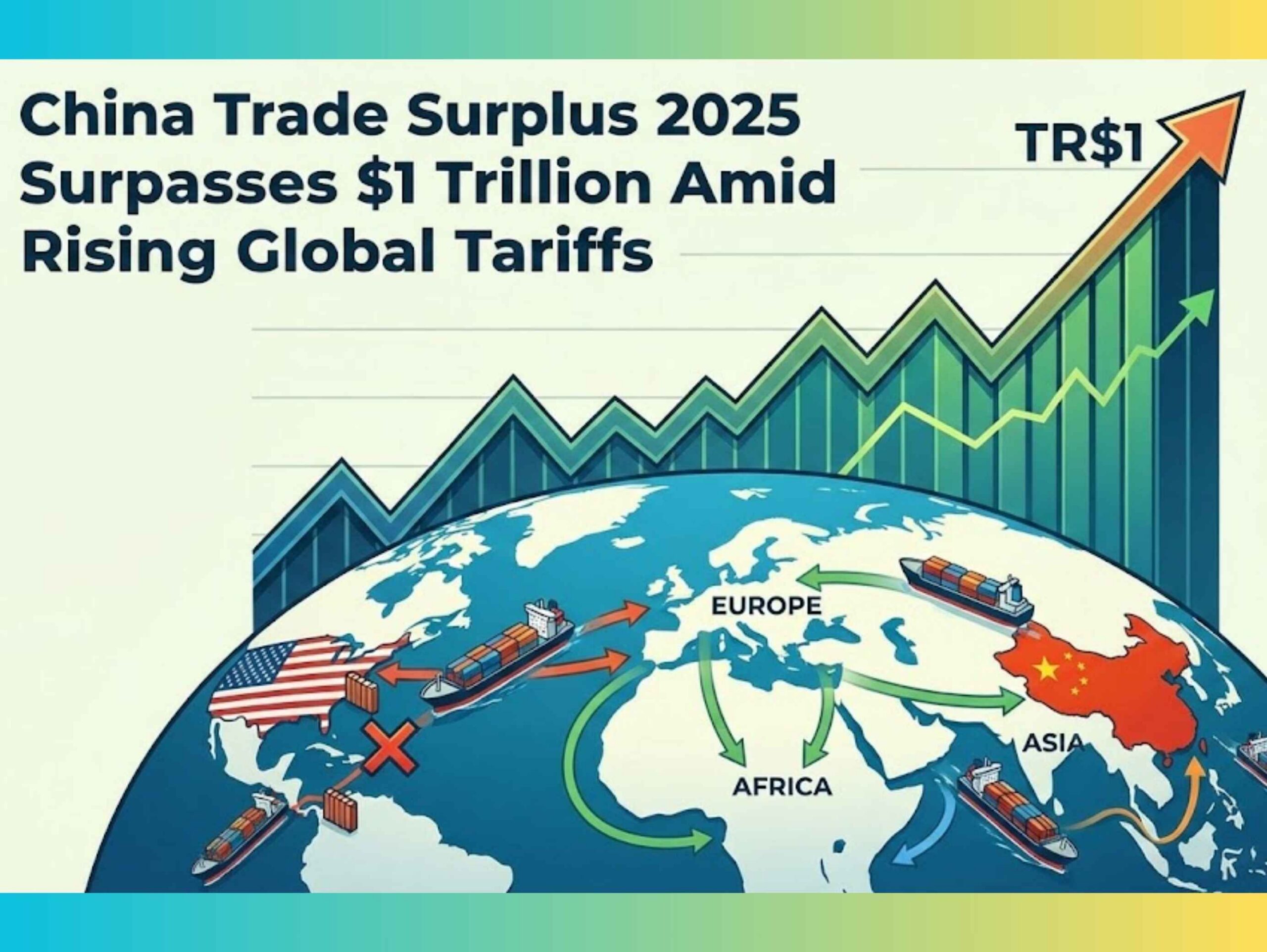
China Trade Surplus 2025 Tops $1 Trillion as Tariff Tensions Rise
Beijing — China’s annual goods trade surplus has exceeded US$1 trillion for the first time, driven by a sharp rebound in exports to non-U.S. markets even as shipments to the United States fell steeply. November’s export rebound and weak imports combined to push the year-to-date surplus past a historic threshold.
Key takeaways
- Record surplus: Year-to-date trade surplus surpassed ~US$1.08 trillion.
- Export rebound: November exports rose ~5.9% year-on-year while imports rose just ~1.9%.
- Market shift: Exports to the EU, Southeast Asia, Australia and Latin America offset large declines to the U.S.
- Policy pressure: Premier Li Qiang urged global institutions to resist protectionism as tariffs rise worldwide.
What happened — the data
Official customs releases show exports rebounded strongly in November, while imports remained muted — a combination that produced a near-record monthly surplus of roughly US$111–112 billion. The cumulative effect through November put the surplus above US$1 trillion.
Why exports rose while U.S. shipments fell
Shipments to the United States fell about 28–29% year-on-year in November amid longstanding tariffs and trade frictions. At the same time, Chinese exporters shifted volumes to the European Union, ASEAN countries, Australia and Latin America. Industry analysts describe this as a deliberate market diversification that has cushioned overall export activity.
Analyst view
“U.S. import tariffs have diverted Chinese exports to other destinations,” says Fred Neumann, HSBC’s chief Asia-Pacific economist. Economists caution that while tariffs alter trade flows, they do not automatically correct macroeconomic imbalances such as China’s reliance on external demand.
Global reaction and risks
Policymakers in Europe and elsewhere have voiced concern. French leaders signalled readiness to consider countermeasures, and the European Commission has been studying resilience measures in response to cheap imports. Market risks include price pressure in sectors where China has large production runs — notably EVs, solar panels, batteries and consumer electronics.
Macro implications
A persistent surplus on this scale can influence currency expectations, change capital flows and heighten calls for trade remedies. Some economists argue that a stronger renminbi or a boost to domestic consumption would be the most durable solutions to ease external pressure — but Beijing appears focused on targeted infrastructure and production policies for now.
Graph: China Monthly Trade Surplus & Export Growth — Jan to Nov 2025

| Month | Export growth (%) | Monthly trade surplus (USD bn) |
|---|---|---|
| Jan 2025 | 2.1 | 95.3 |
| Feb 2025 | 1.8 | 92.1 |
| Mar 2025 | 3.5 | 100.5 |
| Apr 2025 | 2.9 | 98.4 |
| May 2025 | 4.2 | 105.7 |
| Jun 2025 | 3.8 | 102.3 |
| Jul 2025 | 4.5 | 108.6 |
| Aug 2025 | 3.2 | 101.9 |
| Sep 2025 | 4.0 | 106.2 |
| Oct 2025 | 3.5 | 104.1 |
| Nov 2025 | 5.9 | 111.7 |
Policy pressures and outlook
International pressure is mounting for China to rebalance toward consumption. Analysts note that absent a material shift to boost domestic demand, export reliance will likely persist — and with it the international tensions that have prompted tariff talk and policy responses.
For a contemporaneous take on Li Qiang’s remarks and tariff consequences, see Reuters: China’s Li says tariff consequences increasingly evident (Reuters). Additional market context: Bloomberg Markets.
Conclusion
China’s crossing of the US$1 trillion trade surplus threshold in 2025 is a structural signal — not a short-term blip. Export diversification has so far masked U.S. tariff impacts, but global policy choices, currency moves and potential protectionist responses will determine whether this dynamic rebalances or intensifies in 2026.
Want deeper trade & market analysis?
Subscribe to DAILY FINANCE for weekly briefings on global trade flows, policy shifts and market implications.