India US Trade Deal 2026: 7 Big Wins, 18% Tariff Cut & What’s Next
How the landmark tariff reduction reshapes goods, business, and global trade dynamics
What Is the India US Trade Deal 2026?
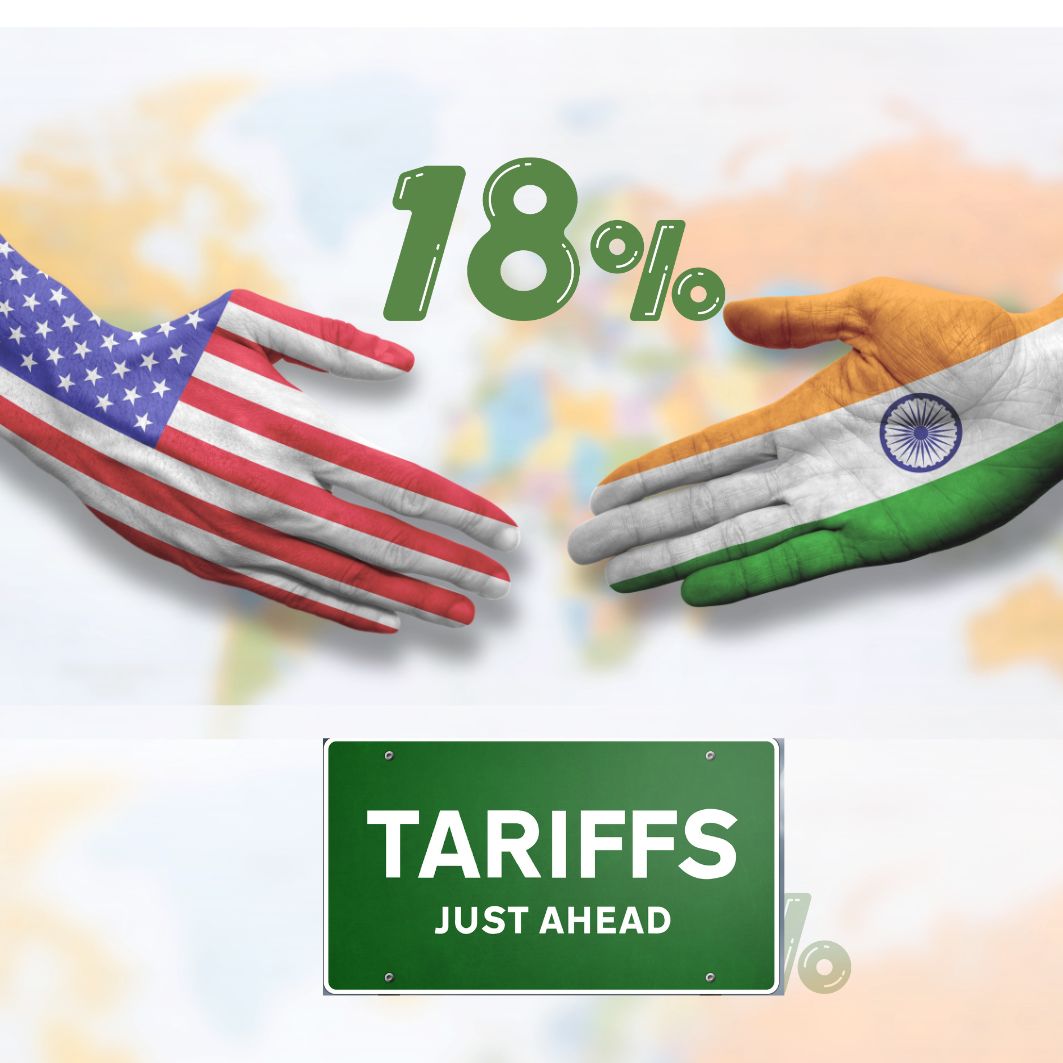
The India US trade deal 2026 refers to the bilateral agreement between India and the United States that reduces U.S. tariffs on Indian goods from an effective 50% to 18%. This landmark deal follows months of tense negotiations triggered by punitive U.S. tariffs imposed over India’s purchases of Russian oil.
President Trump announced the agreement via social media after a phone call with Prime Minister Modi, stating that India had committed to ending Russian oil imports, reducing trade barriers to zero, and purchasing over $500 billion worth of U.S. goods including energy, technology, and agricultural products.
However, no formal Free Trade Agreement text has been released, making this announcement a policy-driven confidence signal rather than a fully ratified treaty. The absence of official documentation raises questions about implementation timelines and long-term stability of the tariff reduction.
How the 18% US Tariff Cut Impacts Indian Goods
The 18% tariff applies broadly to Made in India goods exported to the United States. This includes a diverse range of products that form the backbone of India’s export economy.
Key Goods Categories Affected
These sectors were among the hardest hit when cumulative tariffs reached 50% in August 2025. The rollback immediately restores price competitiveness for Indian exporters operating in the U.S. market, allowing them to compete more effectively against Asian rivals.
Understanding goods in trade context: Goods refer to physical, tangible products that cross international borders. Unlike services (which are intangible activities like consulting or software development), goods include everything from clothing to computer chips. Tariffs are taxes imposed on these physical products when they enter a country, making them more expensive for buyers and less competitive for sellers.
India US Trade Deal 2026: Impact on Business and Exports
The tariff reduction creates immediate and substantial benefits for Indian businesses engaged in international trade, while also generating positive ripple effects across the broader economy.
Direct Business Benefits
Exporters gain breathing room: Indian businesses exporting to the U.S. now face lower landed costs, improved profit margins, and renewed contract visibility. This is particularly critical for small and mid-sized exporters who were struggling to absorb the previous 50% tariff shock without passing costs to customers.
Manufacturing confidence improves: The deal reinforces India’s position as a viable manufacturing alternative within global supply chains, strengthening business cases under the “China plus one” strategy that multinational corporations have been pursuing to reduce dependency on Chinese manufacturing.
IT and services see indirect gains: Although tariffs primarily affect goods, service-led firms such as IT companies benefit from improved bilateral sentiment, stronger enterprise spending in the U.S., and reduced geopolitical policy risk that had been dampening business confidence.
Market Response Validates Confidence
Financial markets rarely wait for paperwork—they price future direction. U.S.-listed Indian companies surged immediately after the announcement, with Infosys closing 4.3% higher, Wipro jumping 6.8%, HDFC Bank gaining 4.4%, and the iShares MSCI India exchange-traded fund rising 3%.
This investor response reflects confidence that trade friction risk has declined materially, earnings visibility has improved for India-exposed firms, and capital flows may stabilize after months of uncertainty and record foreign investor outflows in 2025.
Understanding business in trade: Business refers to companies, investment decisions, contracts, and operations that respond to trade policy changes. Businesses make strategic decisions about where to manufacture, which markets to enter, and how to price products—all based on factors like tariffs. A tariff reduction can transform a money-losing export market into a profitable one overnight.
Trade vs Business vs Goods: Key Distinctions
To fully grasp the significance of the India US trade deal, it’s essential to understand how these three interconnected concepts differ:
| Concept | Definition | Example in This Deal |
|---|---|---|
| Goods | Physical products crossing borders | Textiles, electronics, machinery exported from India to U.S. |
| Business | Companies and operations responding to policy | Infosys stock rises, exporters adjust pricing strategies |
| Trade | Umbrella framework including goods, services, capital, regulations | Overall India-U.S. economic relationship worth $131B annually |
This deal directly impacts goods through tariff changes, indirectly reshapes business decisions around investment and expansion, and strategically repositions the entire trade relationship between the world’s largest democracy and largest economy.
Russian Oil and Energy Trade: The Silent Realignment
One of the most geopolitically sensitive aspects of the India US trade deal 2026 involves energy procurement and India’s relationship with Russia.
President Trump stated that India agreed to stop buying Russian oil and increase purchases from the United States and potentially Venezuela. Indian officials have not formally confirmed this commitment, maintaining their long-standing position that oil imports are purely commercial decisions driven by market factors and energy security needs.
Actions Speak Louder Than Words
However, trade data reveals a quiet but deliberate transition already underway. Russian crude imports to India have fallen sharply, with a 29% month-on-month reduction recorded in recent months—the lowest volumes since international price cap policies were implemented on Russian oil.
Key Energy Transition Data
📉 38% reduction in Russian oil orders by Indian refiners compared to previous year
🛢️ Zero Russian oil received by Reliance Industries in January 2026
📊 29% month-on-month drop in overall Russian crude imports
This suggests India is achieving alignment with U.S. geopolitical priorities through action rather than formal declaration, allowing New Delhi to balance energy security concerns with diplomatic flexibility and avoid appearing to capitulate to external pressure on sovereign decisions.
Regional Trade Competitiveness: Where India Stands
The new 18% tariff rate significantly improves India’s competitive position in the U.S. market relative to regional rivals, though gaps remain.
Tariff Comparison Across Asian Exporters
| Country | U.S. Tariff Rate | GSP Benefits |
|---|---|---|
| India | 18% | No (withdrawn 2019) |
| Vietnam | 20% | Yes (~5% additional advantage) |
| Bangladesh | 20% | Yes (~5% additional advantage) |
| Pakistan | 19% | Yes (~5% additional advantage) |
| China | 34% (delayed to Nov 2026) | No |
While the 18% rate brings India closer to parity with neighbors, the absence of Generalized System of Preferences (GSP) benefits still gives competitors approximately a 5% effective advantage. Indian exporters had hoped for a reciprocal tariff rate around 15% to fully level the playing field.
Nevertheless, this represents a dramatic improvement from the 50% disadvantage India faced just months ago, and positions Indian manufacturers competitively for the first time since August 2025.
Why the India US Trade Agreement Matters for Global Trade
The India US trade deal 2026 sends powerful signals that extend far beyond bilateral economics, reshaping the architecture of global trade in a fragmenting world order.
Strategic Implications
Trade becomes strategic, not just economic: This deal demonstrates that in 2026, tariff policy serves multiple purposes beyond revenue collection. Tariffs are now diplomatic tools, geopolitical leverage points, and strategic alignment mechanisms.
Supply chain realignment accelerates: For the United States, this agreement reinforces supply chain diversification away from China by strengthening trade with a trusted democratic partner. For India, it secures long-term strategic relevance in future global supply chains.
Emerging markets that integrate geopolitics with trade gain leverage: Countries that can demonstrate geopolitical alignment while maintaining economic competitiveness position themselves favorably in an era where commerce and diplomacy are increasingly inseparable.
The Broader Trade Context
Trade encompasses the entire framework of economic exchange between nations—not just goods crossing borders, but also services, intellectual property, investment flows, regulatory standards, and diplomatic relationships. The India US trade deal operates at this comprehensive level, affecting everything from individual product prices to geopolitical alliances.
For Asia, this deal reshapes competitive dynamics and forces other nations to reassess their own trade strategies. For global investors, it reinforces India’s growing importance in diversified portfolios. For policymakers worldwide, it highlights that trade stability now requires as much diplomatic skill as economic negotiation.
Critical Timeline: From Crisis to Breakthrough
United States imposes 25% reciprocal tariff plus additional 25% penalty on countries purchasing Russian oil, creating an effective 50% tariff burden on Indian goods—the highest imposed on any country alongside Brazil.
Indian exports suffer significant declines. Major refiners begin quietly reducing Russian oil orders, with October showing 38% decrease compared to previous year. Bilateral negotiations intensify behind the scenes.
Russian crude imports to India record 29% month-on-month reduction to lowest levels since price cap implementation. Strategic shift becomes evident in data despite absence of public policy announcements.
Reliance Industries, one of India’s largest refiners, publicly announces zero Russian oil receipts for January and confirms no Russian oil received in final three weeks of December. Energy transition accelerates.
Trump and Modi announce breakthrough agreement during phone call. U.S. tariffs reduced to 18%, removing penalty layer. Markets surge on reduced friction expectations. Full FTA negotiations expected to conclude during 2026.
Unanswered Questions and Future Outlook
Despite the positive momentum, several critical questions remain unresolved that will determine the long-term success and stability of this agreement.
Legal Framework Uncertainty
No Federal Register notice or presidential proclamation has been issued formalizing the tariff changes. The effective implementation date remains unclear, and without official documentation, the durability and reversibility of these tariff reductions cannot be fully assessed.
Free Trade Agreement Status
It remains ambiguous whether this represents a standalone political settlement or forms part of the broader India-U.S. Free Trade Agreement that has been under negotiation since early 2025. Unlike the recently concluded EU-India FTA, no negotiated text has been made public.
Investment Commitment Verification
Trump’s claim that India committed to purchasing over $500 billion worth of U.S. goods has not been validated by Indian officials. Given current bilateral trade stands at approximately $131 billion annually, this figure would require multi-year, multi-sector execution—but no timeline or sector breakdown has been provided.
Non-Tariff Barriers
Trump stated India would reduce tariffs and non-tariff barriers “to zero,” but Indian officials have neither confirmed nor detailed which specific barriers would be eliminated. Critical questions remain about agricultural market access, particularly for soybeans and dairy products where India maintains protective restrictions.
Strategic Autonomy Concerns
The withdrawal of U.S. sanctions waivers on Iran’s Chabahar port project and India’s apparent reduction in Iranian trade exposure raises questions about strategic autonomy. The Union Budget 2026 showed zero allocation for Chabahar, suggesting India is preparing to step back from the 23-year infrastructure project—at least temporarily—to avoid additional U.S. tariff threats.
Final Strategic Takeaway
The India US trade deal 2026 represents a high-impact confidence signal for exporters, businesses, and financial markets. The 18% tariff cut delivers immediate economic relief and demonstrates that diplomacy between the world’s largest democracy and largest economy can produce concrete results even amid complex geopolitical tensions.
However, this agreement is more accurately understood as a tactical confidence-building measure rather than a comprehensive trade architecture. It opens momentum but does not close the chapter on India-U.S. trade relations.
The real test lies in execution: Will tariffs drop further toward the 15% level Indian exporters hoped for? Will non-tariff barriers genuinely fall to zero as claimed? Will energy commitments fundamentally reshape India’s strategic posture and relationships with Russia and Iran? Can the broader Free Trade Agreement be finalized with terms that satisfy both domestic constituencies and international competitiveness requirements?
For businesses: This creates a more favorable environment for U.S. market expansion but requires monitoring of implementation details and FTA negotiations.
For investors: The deal reduces policy uncertainty and improves India’s attractiveness within emerging market portfolios, though execution risk remains.
For policymakers: Success requires balancing immediate economic gains with long-term strategic autonomy, ensuring India’s energy security isn’t compromised and sovereign decision-making capacity is preserved.
Understanding Evolves, Trade Continues
This is a strong opening move in recalibrating India-U.S. trade relations for a multipolar world. The journey from 50% tariffs to 18% represents meaningful progress, but the path to comprehensive trade partnership requires sustained diplomatic effort, mutual economic benefit, and strategic trust.
Stay Updated on Global Trade & Finance
Get the latest insights on international trade deals, market movements, and economic policy analysis.
Follow Daily Finance →