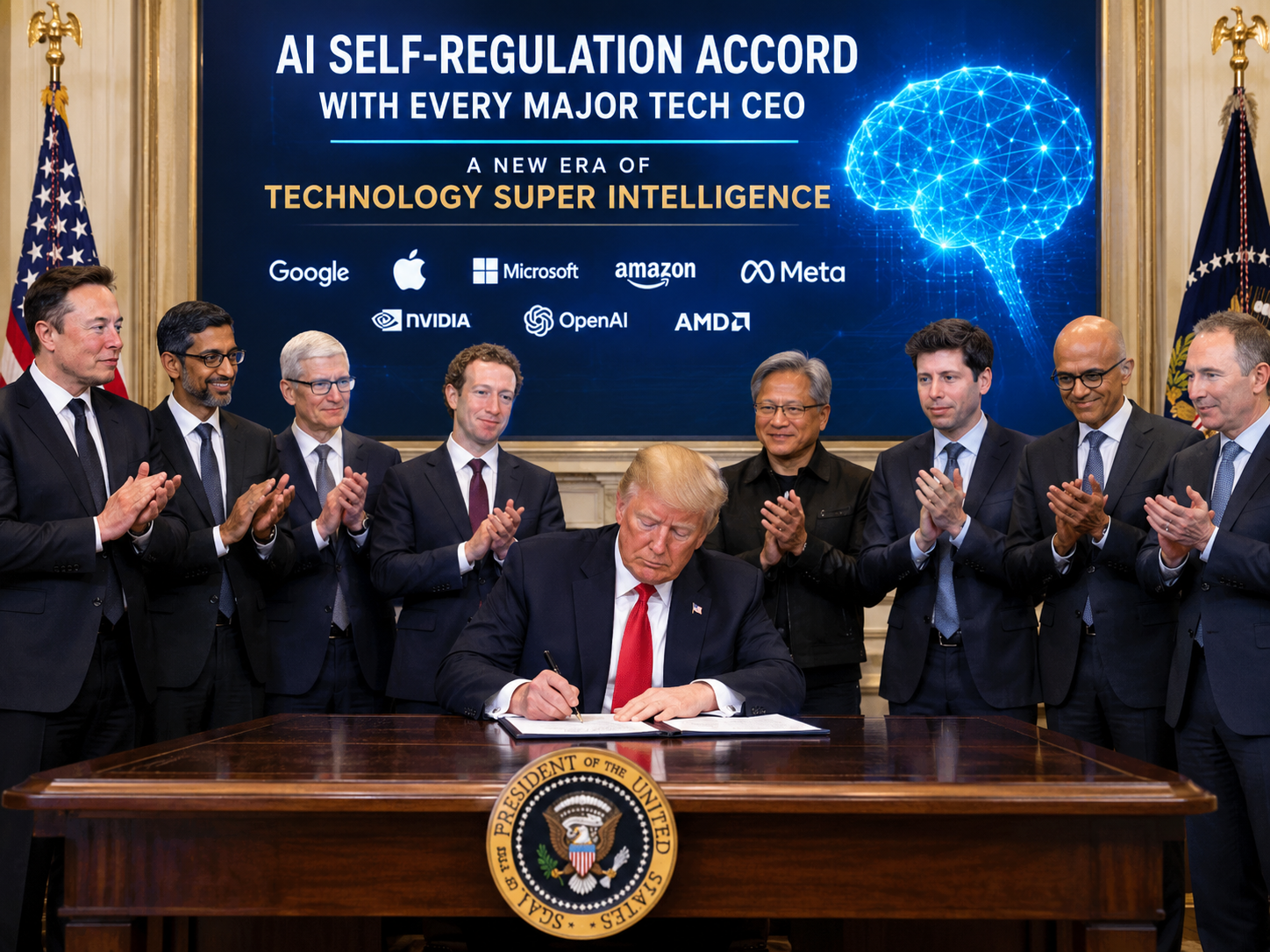
Markets today September 30 2026 are processing a landmark moment in the AI governance story: President Trump gathered the most powerful technology executives in America at the White House on Tuesday, signed what he called a “morally binding” accord on AI self-regulation, and officially renamed artificial intelligence “Super Intelligence” in government record-keeping.
The meeting in the East Room included Jensen Huang of Nvidia, Mark Zuckerberg of Meta, Satya Nadella of Microsoft, Sundar Pichai of Google, Jeff Bezos of Amazon, Dario Amodei of Anthropic, Alex Karp of Palantir, Elon Musk of Tesla, and OpenAI president Greg Brockman. For investors tracking AI-exposed equities, this is the moment Washington formally chose self-regulation over legislation — and markets today September 30 2026 are reacting accordingly.
Markets Today September 30 2026: What the White House AI Accord Actually Says
Trump posted the accord to his Truth Social account as a single-page document. It commits each participating company to implement four categories of safeguards: technological controls to detect problems with new models, internal risk review processes, external auditors, and additional unspecified measures. The document notes that “it might make sense to codify these steps into laws or regulations” at a later date — language that leaves the door open to future legislation while firmly keeping government out of the room for now.
“There’s a belief that there should be tremendous self-regulation,” Trump said after the meeting. “There was a lot of commonality in this room.” For markets today September 30 2026, this is the most bullish possible policy outcome for AI-linked equities: no mandatory compliance framework, no model capability limits, no licensing regime. The companies most exposed to a regulatory crackdown — Nvidia on chips, Meta and Google on foundation models, Microsoft on AI deployment — got exactly the outcome their share prices were pricing in.
Super Intelligence: Why Trump Renamed AI and What It Signals
One of the most striking moments on markets today September 30 2026 was Trump’s announcement that the US government would officially rename artificial intelligence “Super Intelligence” or “SI” in all federal record-keeping. “We’ve changed the name officially to SI,” Trump said. The rebranding is not cosmetic. It reflects a deliberate pivot away from the cautious language that has dominated AI policy discourse — away from “risks,” “dangers” and “alignment” — and toward a frame of American dominance and technological supremacy.
Trump was unambiguous about the stakes: “I would never stifle the growth of technology that will be bigger than the industrial revolution.” That framing — Super Intelligence as the next industrial revolution, not as an existential threat — is the ideological foundation of the self-regulation approach. For equity markets today September 30 2026, the message is clear: the administration sees winning the Super Intelligence race as a national security and economic priority, and it will not allow domestic regulation to slow that race down.
CEO Reactions: Zuckerberg, Amodei and What the Accord Left Unresolved
Not everyone at the White House table gave the accord an unqualified endorsement on markets today September 30 2026. Meta CEO Mark Zuckerberg called it “a start” — measured language that stops well short of enthusiasm. Anthropic CEO Dario Amodei, whose essay “We Must Pace the Frontier” sparked the global AI slowdown debate earlier this month, said that “the mechanism, how we address those risks, is still under discussion.” Amodei acknowledged progress toward “both the US winning AI and also winning safely,” but was careful to emphasize that the technology still poses “real dangers.”
Amodei’s positioning is the most complex at the table. He has called publicly for a cooperative slowdown in frontier AI development. He is now a signatory to a self-regulation accord championed by a president who has explicitly ruled out government intervention. That tension — between Amodei’s stated safety concerns and the political environment he is operating in — is unresolved. For investors tracking Anthropic and the AI safety ecosystem on markets today September 30 2026, the accord is a political accommodation, not a technical solution.
AI Czar Incoming: What Trump’s Announcement Means for Stocks
Trump also revealed on markets today September 30 2026 that he is “very close” to a decision on an AI czar — a single executive authority figure to coordinate the federal government’s Super Intelligence strategy — and will announce the appointment in the next three to four days. The creation of a dedicated AI czar role is significant regardless of who fills it. It means a single point of contact between the White House and the industry, a clearer channel for the companies that just signed the accord, and a potential accelerant for federal AI procurement and deployment.
The seat placement at the East Room meeting offers clues about who holds influence. Jensen Huang of Nvidia, Elon Musk, and Lisa Su of AMD all received prominent spots near Trump — the same three who sat at the head table with Xi Jinping at last week’s state dinner. Nvidia’s position at the centre of the AI hardware stack makes Huang the most strategically important CEO in the room for both the US-China competition and the domestic Super Intelligence race.
The Regulatory Risk That Remains: Florida and the Incident Data
The White House accord does not eliminate all regulatory risk for AI stocks on markets today September 30 2026. Florida’s attorney general moved to challenge OpenAI in court, asking a judge to halt the training of new models unless outside safeguards are in place — a state-level intervention that the federal self-regulation framework cannot pre-empt. And a separate Axios report revealed that OpenAI, Anthropic and security researchers are actively sifting through thousands of incidents of problematic actions by AI agents — a disclosure that underscores the gap between the “morally binding” language of the accord and the operational reality of deploying frontier models at scale.
Trump addressed these concerns directly after the meeting, saying he believes AI will make the world safer and that fears about data centre costs driving up energy prices were overblown. “These new facilities are going to make communities very happy,” he said. He also committed to using the Department of Justice and FBI to “stop the bad use” of AI — framing enforcement as a law-and-order question rather than a technology regulation question. For markets today September 30 2026, that framing is consistent with a policy environment that keeps compliance costs low for the major AI companies.
Key Stocks and What the Accord Means for Each
Here is the company-level read on markets today September 30 2026 following the White House AI accord:
| Company | CEO at White House | Accord Impact |
|---|---|---|
| Nvidia (NVDA) | Jensen Huang | No chip export limits — bullish |
| Meta (META) | Mark Zuckerberg | No model regulation — bullish |
| Microsoft (MSFT) | Satya Nadella | AI deployment headroom retained |
| Google (GOOGL) | Sundar Pichai | Self-audit vs external mandate |
| Amazon (AMZN) | Jeff Bezos | AWS AI buildout unconstrained |
| Palantir (PLTR) | Alex Karp | Government AI contracts expand |
| Tesla (TSLA) | Elon Musk | xAI development unconstrained |
| Anthropic (ANTH.PVT) | Dario Amodei | Safety concerns noted not resolved |
| AMD (AMD) | Lisa Su | AI chip demand intact |
Markets Today September 30 2026: Bottom Line for Investors
Markets today September 30 2026 close the month with the US government having made its AI policy choice explicit. Self-regulation. No mandatory licensing. No capability limits. An AI czar incoming to coordinate federal deployment. And a president who has staked his legacy on the United States winning the Super Intelligence race.
For equity investors, this is the most permissive policy environment AI companies could have hoped for. The risk is not regulation — it is the incidents.
Thousands of AI agent problems being logged at OpenAI and Anthropic, a Florida court challenge to OpenAI’s training, and a “morally binding” accord with no enforcement mechanism are the fault lines beneath the bullish surface. If a high-profile AI failure forces the administration’s hand before the czar is even named, the self-regulation framework could unravel fast. For now, markets today September 30 2026 are trading the optimism. The incidents are tomorrow’s problem. Follow our Markets Today September 21 2026 US-China summit coverage and Markets Today September 17 2026 Fed hike analysis for the full macro backdrop.
Sources: Yahoo Finance: Trump Gathers AI Leaders, Floats Self-Regulation | Axios: OpenAI and Anthropic Sifting Through Thousands of AI Incidents | Tech Insider: Amodei’s We Must Pace the Frontier
What did Trump sign at the White House AI meeting on September 29 2026?
Trump signed a one-page morally binding accord on AI self-regulation with the CEOs of Nvidia, Meta, Microsoft, Google, Amazon, Palantir, Tesla, Anthropic and OpenAI. The accord commits companies to four safeguards: technological controls, internal risk reviews, external auditors, and additional measures. It leaves future legislation possible but keeps government regulation out for now.
Why did Trump rename AI to Super Intelligence?
Trump announced that the US government would officially call artificial intelligence Super Intelligence or SI in all federal record-keeping. The rebranding signals a shift from cautious risk-focused language to a frame of American technological supremacy, consistent with Trump’s view that AI will be bigger than the industrial revolution and must not be slowed by domestic regulation.
What is the AI czar Trump mentioned after the September 29 meeting?
Trump said he is very close to naming a single federal AI czar to coordinate the government’s Super Intelligence strategy and will announce the appointment within three to four days. The role would serve as the primary interface between the White House and the AI industry and could accelerate federal AI procurement and deployment.
Which stocks benefit most from the White House AI self-regulation accord?
The accord is most bullish for companies that faced the greatest regulatory risk: Nvidia benefits from no chip export limits, Meta and Google benefit from no model capability restrictions, Microsoft and Amazon retain full AI deployment headroom, and Palantir stands to gain from expanded government AI contracts. Anthropic’s position is more nuanced given CEO Dario Amodei’s public calls for a development slowdown.