Live · Updated: Monday, April 13, 2026 | Global Finance · Energy · Markets
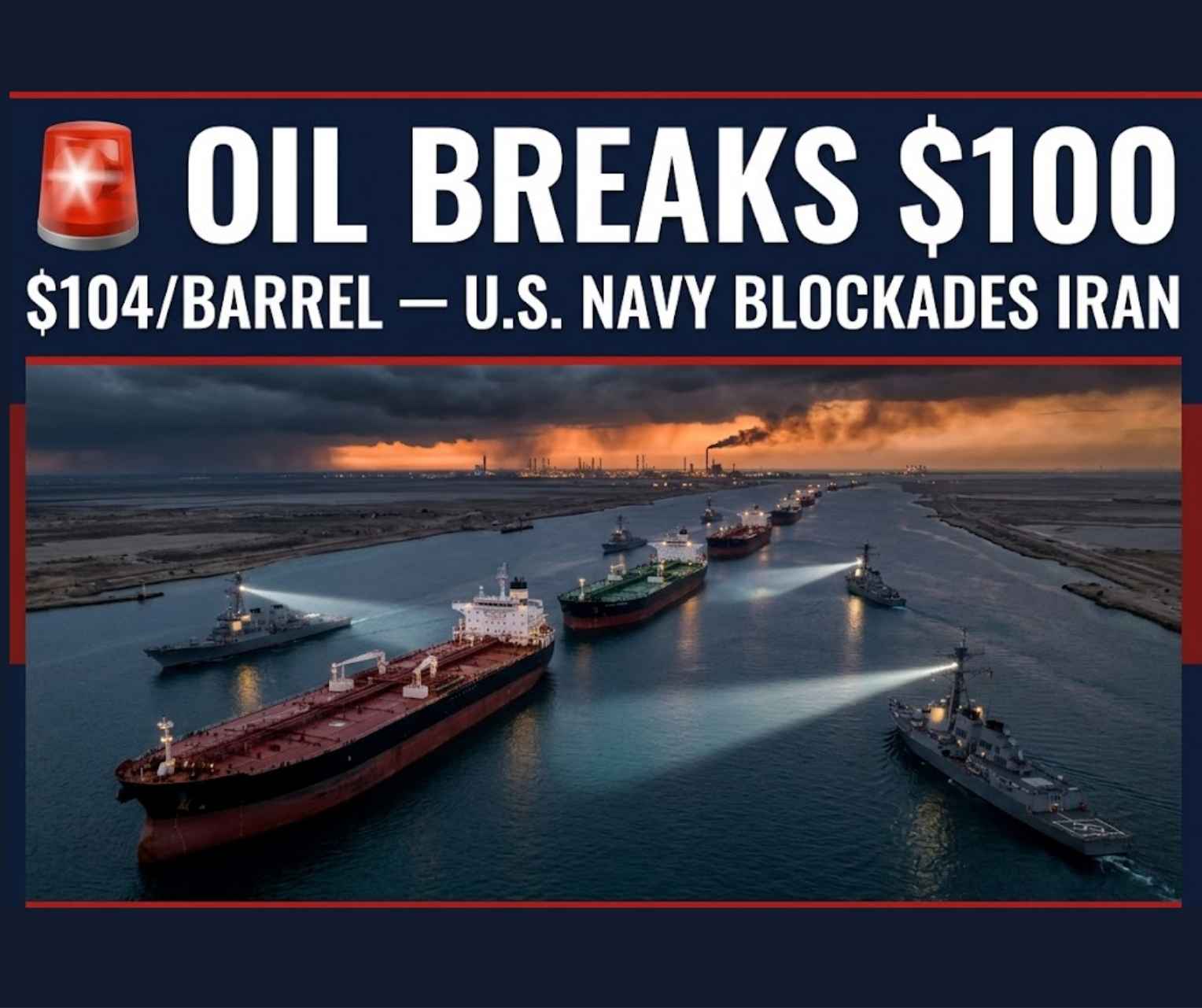
BREAKING: Oil Tops $100 as U.S. Navy Blockades Iran
This is the largest oil supply disruption in modern history.
Crude oil has officially crossed the $100 barrier, with WTI crude futures spiking nearly 8% to $104.20 per barrel, and Brent crude climbing 7% to $101.86. The surge comes as the U.S. Navy prepares to enforce a full naval blockade on Iranian ports, beginning Monday at 10 a.m. ET.
The move marks a dramatic escalation in the ongoing U.S.–Iran conflict and has already sent shockwaves through global energy markets.
The blockade, announced by U.S. Central Command, will target all maritime traffic entering or exiting Iranian ports — while sparing vessels transiting to non-Iranian destinations. President Donald Trump took to Truth Social, declaring: “The United States Navy, the Finest in the World, will begin the process of BLOCKADING any and all Ships trying to enter, or leave, the Strait of Hormuz.”
Why This Oil Price Surge Is Different
This isn’t just another oil price volatility event. Three factors make this moment unique:
1. The Strait of Hormuz crisis is at its peak. The narrow waterway — responsible for nearly 20% of global oil supply — has seen tanker traffic plummet from over 100 daily vessels to just a handful. Three supertankers made the crossing on Saturday, but that is a fraction of pre-war levels.
2. The Trump Hormuz blockade announcement is now policy. U.S. Central Command has confirmed the U.S. will interdict any ship in international waters that has paid Iran a toll to transit the strait. Iranian senior advisor Ali Akbar Velayati responded that the “key to the Strait of Hormuz” remains in Iran’s hands.
3. This is the largest oil supply disruption on record. With Middle East oil producers cut off from their primary export route, supply chains are facing the tightest squeeze since the 1973 oil crisis.
U.S. Navy Iran Ports Blockade: What Happens Monday
At 10 a.m. ET Monday, the U.S. Navy begins enforcement across all Iranian ports on the Arabian Gulf and Gulf of Oman. The blockade will be enforced impartially against vessels of all nations, marking a significant shift in how Washington is approaching the Middle East oil supply disruption.
Meanwhile, President Trump is reportedly considering limited strikes on Iran to break the diplomatic stalemate, according to The Wall Street Journal. The combination of a naval blockade and potential military action has traders pricing in a crude oil price surge that could push WTI toward $120 per barrel.
The Talks Failed: JD Vance Returns from Islamabad Without a Deal
Peace negotiations in Islamabad collapsed over the weekend, with U.S. Vice President JD Vance leaving without any agreement after Iran refused to commit to abandoning its nuclear program.
The U.S.–Iran negotiations in Islamabad had raised hopes for a ceasefire extension, but Tehran’s leadership, including Mohammad-Bagher Ghalibaf, accused Washington of failing to earn trust. Iran is now demanding control over the Strait of Hormuz, war reparations, and the release of frozen assets.
Pakistan officials say they will attempt to restart talks in the coming days. But for now, the gap between Washington and Tehran has only widened.
INFLATION SPIKE: U.S. CPI Hits 3.3%, Fed to Hold Rates
The macroeconomic picture just got darker. The March 2026 CPI report revealed U.S. headline inflation at 3.3% year-over-year, driven primarily by soaring energy prices as gasoline costs jumped alongside crude.
What this means for the Federal Reserve:
The March CPI report has essentially ended any near-term hopes of rate cuts. The Fed is now expected to hold rates steady, prioritizing inflation control over growth support. The Fed’s 2026 rate decision is likely to keep monetary policy tight as long as energy-driven inflation persists.
IMF cuts 2026 global growth outlook. In a concerning parallel development, the International Monetary Fund has announced plans to downgrade its worldwide growth forecasts for 2026, citing geopolitical risk and the ongoing Middle East conflict as key headwinds.
Stagflation risk 2026 is now a mainstream concern. The combination of slowing global growth and persistent inflation has economists and market strategists dusting off a term last seen in the 1970s: stagflation. Higher energy costs and GDP pressure are creating a perfect storm where traditional policy tools lose effectiveness.
The IMF Stagflation Warning: What Markets Are Missing
The IMF’s decision to cut global growth forecasts while inflation remains stubborn represents the worst possible scenario for investors. Central banks and the energy shock are now operating at cross purposes — raising rates to fight inflation could trigger recession, while easing to support growth risks unleashing further price pressures.
Energy prices are now the primary transmission channel from geopolitics to consumer wallets. Oil at $104 per barrel and Brent crude above $101 mean gasoline prices will keep pushing headline inflation higher, regardless of what the Fed does.
DOW FUTURES DROP 500 POINTS: Markets Open in Panic Mode
The market reversal is stunning.
Just one week ago, the S&P 500 rallied 3.6% on ceasefire hopes, marking its best week since November. The Dow gained 3%, and the Nasdaq jumped nearly 4.7%. That optimism evaporated overnight.
Dow futures are down 517 points, or 1.1%. S&P 500 futures fell 1.1%, and Nasdaq 100 futures shed 1.2% as Monday morning trading began. Stock futures fell on the Hormuz blockade announcement, with traders rapidly repricing risk across every asset class.
Asia Markets Decline on Oil Shock
The contagion spread instantly across the Asia-Pacific session:
| Market | Performance | Key Driver |
|---|---|---|
| India Nifty 50 | -2.0% | Energy import exposure |
| Japan Nikkei 225 | -1.09% | Oil price sensitivity |
| Hong Kong Hang Seng | -1.22% | Geopolitical risk-off |
| South Korea Kospi | -1.26% | Export slowdown fears |
| Australia S&P/ASX 200 | -0.53% | Commodities mixed |
India’s Nifty 50 emerged as the worst performer among major Asian indices, reflecting how energy-importing emerging markets face the dual pressure of higher oil costs and currency weakness.
The Nikkei and Nifty fall today mirrors the broader risk-off sentiment gripping global equities. With crude oil price surge today sending energy costs higher, Asian economies that rely heavily on imported oil are feeling the pinch immediately.
Why Wall Street Banks Matter This Week
Adding complexity to the sell-off, first-quarter earnings season kicks off this week. Goldman Sachs reports Monday, followed by Citigroup, Wells Fargo, JPMorgan Chase, Morgan Stanley, and Bank of America throughout the week.
The Goldman Sachs Q1 2026 earnings could provide crucial insight into how trading desks are positioning for geopolitical risk and equities. If banks flag energy exposure or credit deterioration from oil price spikes, the market reaction could deepen.
Key Themes at a Glance: What’s Moving Markets Today
| Theme | What’s Happening | Why It Matters |
|---|---|---|
| Oil prices above $100 | WTI and Brent surge on U.S. Navy Iran ports blockade | Energy costs push inflation higher globally |
| Strait of Hormuz crisis | Tanker traffic collapsed from 100+ daily to a handful | 20% of global oil supply at risk |
| U.S. inflation 3.3% March 2026 | CPI driven by gasoline and energy | Fed expected to hold rates indefinitely |
| IMF cuts 2026 global growth | Downgrade cites Middle East conflict | Stagflation risk enters mainstream |
| Dow futures drop 500 points | S&P 500, Nasdaq futures off ~1% | Ceasefire optimism replaced by risk-off |
| Asia markets decline | Nikkei, Nifty, Kospi, Hang Seng all down | Energy importers hit hardest |
| Trump Hormuz blockade | U.S. Navy to interdict Iran-linked shipping | Potential for direct military escalation |
What Traders Need to Know Right Now
The Three-Pressure Framework
Markets are navigating three overlapping forces simultaneously:
1. Rising oil prices and crude oil price surge today — WTI at $104+, Brent above $101 — are feeding directly into global inflation. The Middle East oil supply disruption is the tightest on record, with the Iran war impact on oil now being priced into every energy-linked asset.
2. Geopolitical risk and equities are at their most fragile level since the war began. The U.S.–Iran negotiations in Islamabad collapsed, and the U.S. Iran war market impact is now a daily headline. Trump is considering limited strikes on Iran, which could trigger a further geopolitical risk spike.
3. Economic uncertainty and the stagflation risk 2026 is the macro backdrop. The IMF’s decision to cut global growth forecasts alongside the U.S. March CPI report at 3.3% creates a policy trap where central banks can neither fight inflation nor support growth effectively.
The Scenarios Ahead
| Scenario | Probability | Oil Price Target | Market Impact |
|---|---|---|---|
| Blockade holds, no escalation | 40% | $110–$120/bbl | Gradual equity stabilization |
| Limited strikes on Iran | 35% | $130+/bbl | Sharp equity sell-off, flight to safety |
| Diplomatic breakthrough | 25% | $85–$95/bbl | Sharp relief rally, V-shaped recovery |
The Bottom Line: Volatility Is the New Normal
The global economy has entered a regime where geopolitical events, not fundamentals, dominate pricing. Oil crossing $100 is a watershed moment — it signals that energy security is now the primary driver of inflation, growth, and market sentiment.
For investors: defensive positioning, energy hedges, and reduced exposure to rate-sensitive sectors are the logical response. The risk-off sentiment global markets are showing today could persist for weeks.
For businesses: supply chain resilience and energy cost hedging are no longer optional. The energy market geopolitical risk is structural, not cyclical.
For policymakers: the stagflation trap is real. The Fed holding rates while the IMF cuts growth forecasts creates a narrowing window for soft landings.
This isn’t a blip. This is the new baseline. And in this environment, agility beats prediction every time.