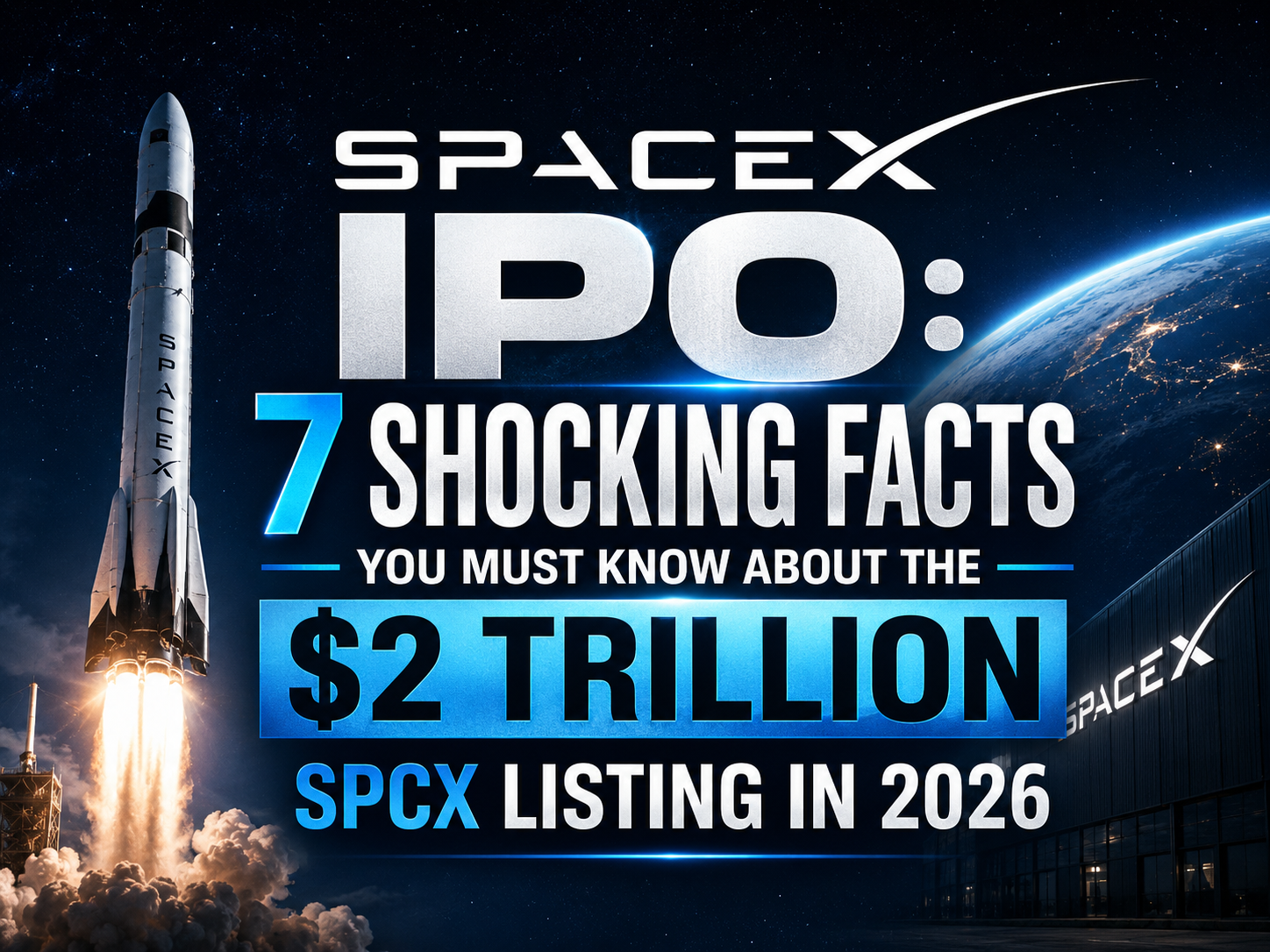
The SpaceX IPO is no longer a rumour circulating in venture capital circles. It is happening. And the details buried inside the 270-page SEC prospectus reveal a company that has quietly reinvented itself into something Wall Street has genuinely never seen before.
Filed on May 20, 2026, the SpaceX IPO prospectus pulls back the curtain on a business that lost $4.27 billion in a single quarter, is spending at the same scale as Amazon Web Services on AI infrastructure, and is simultaneously planning to colonise Mars while listing on the Nasdaq under ticker symbol SPCX.
If that sounds like too much for one filing, it is. But investors are lining up anyway.
Here are seven facts that define the most anticipated public market debut in history.
Table of Contents
- SpaceX IPO Date, Ticker, and What Is Actually Being Offered
- The $4.27 Billion Loss That Shocked Analysts
- Why the SpaceX IPO Is Really Three Companies in One
- Binance Is Already Letting Traders Bet on SPCX Before Listing Day
- Elon Musk’s Billion-Share Mars Compensation Deal
- The Red Flags SpaceX Disclosed in Its Own Filing
- What the SpaceX IPO Actually Means for Public Markets
1. SpaceX IPO Date, Ticker, and What Is Actually Being Offered
The SpaceX IPO is targeting a Nasdaq listing on or around June 12, 2026 under ticker symbol SPCX. Goldman Sachs is serving as lead bookrunner on a syndicate of 21 banks that includes Morgan Stanley, Bank of America, Citigroup, and JPMorgan.
The offering is expected to raise between $75 billion and $80 billion, which would make it the largest IPO in recorded stock market history by a significant margin.
SpaceX is targeting a post-listing valuation of $1.75 trillion to $2 trillion. If achieved, the company would rank among the five most valuable businesses on Earth from day one of trading.
The prospectus states that IPO proceeds will be directed toward AI compute infrastructure expansion, Starship vehicle upgrades, satellite constellation scaling, space-based solar energy commercialisation, and long-term Mars colonisation efforts. SpaceX estimates its total addressable market at $28.5 trillion.
2. The $4.27 Billion Loss That Shocked Analysts
The SpaceX IPO filing is generating enormous attention for one number above all others: a net loss of $4.27 billion for Q1 2026 alone.
That compares to a net loss of just $528 million in the same quarter the previous year. The bottom line deteriorated by $3.74 billion year over year in a single quarter, which is an extraordinary acceleration in losses for a company asking public markets to value it at nearly $2 trillion.
Total costs and expenses surged to $6.63 billion from $4.04 billion. Research and development spending jumped 125.7 percent to $3.51 billion, making it the single largest cost driver in the quarter.
The SEC filing attributes the spike to $1.47 billion in higher AI segment costs from GPU hardware depreciation, cloud computing, and data centre infrastructure build-out, combined with $404 million in additional Starship development costs.
AI capital expenditure alone reached $7.7 billion in Q1 2026, placing SpaceX in the same infrastructure spending tier as Amazon, Google, and Microsoft.
Revenue did grow. Total revenue for Q1 2026 reached $4.69 billion, up 15.4 percent from $4.06 billion in Q1 2025. For the full year 2025, SpaceX posted $18.7 billion in revenue against a net loss of $4.9 billion. The company holds $15.9 billion in cash and carries $29.1 billion in long-term debt.
3. Why the SpaceX IPO Is Really Three Companies in One
SpaceX IPO Segment Breakdown: Rockets, Starlink, and xAI
Investors buying SPCX stock on listing day will not simply be buying a rocket company. The SpaceX IPO bundles three structurally distinct businesses into a single public vehicle.
The Rocket Business
Launch services remain the foundation of the SpaceX brand. However, Space segment revenue declined slightly in Q1 2026 due to fewer commercial launch missions and shifts in government contract timing. Despite its iconic status, the rocket business is no longer the primary growth engine inside the filing.
Starlink Satellite Internet
Starlink is now the company’s most powerful revenue growth driver. The connectivity segment added $782 million in Q1 2026 as the subscriber base continued expanding globally. Analysts increasingly view Starlink as a potential dominant global communications layer, particularly in markets where terrestrial internet infrastructure remains underdeveloped. No comparable publicly traded satellite internet business exists at this scale.
xAI and AI Infrastructure
Earlier in 2026, Elon Musk sold his AI startup xAI into SpaceX, making artificial intelligence a formal third segment of the company. xAI operates the Colossus data centres in Tennessee and generated $3.2 billion in revenue in 2025. However, it lost $6.4 billion in the same period, with capital spending running more than three times higher than the rocket business. The AI segment is the largest source of both cost growth and long-term valuation speculation inside the SpaceX IPO.
This three-segment structure means SPCX stock does not fit neatly into any existing investment category. It is simultaneously an aerospace stock, a telecom stock, and an AI infrastructure stock.
4. Binance Is Already Letting Traders Bet on SPCX Before Listing Day
One of the most striking developments surrounding the SpaceX IPO has nothing to do with SpaceX directly. It involves Binance.
Binance launched what it describes as the first pre-IPO perpetual futures contract tied to SPCX, allowing retail traders to gain leveraged price exposure to SpaceX before the company officially lists on any public exchange.
The debut numbers were extraordinary. Over $85 million traded within hours of the contract going live. SPCX moved from $197 to $224, representing a 13 percent jump before volatility rapidly reversed the gains.
According to a report by AMBCrypto, Binance co-CEO Richard Teng described the product as a democratisation of IPO access, arguing that pre-IPO pricing has historically been locked behind institutional and private investor allocations. Read the full AMBCrypto report here.
Hyperliquid has launched similar pre-IPO markets, and prediction platform Polymarket currently assigns roughly a 70 percent probability to SpaceX reaching a $2 trillion valuation after listing.
Retail traders should understand one critical distinction. Trading Binance SpaceX futures is not the same as owning equity in SpaceX. These are synthetic instruments that track expected future valuations. Several companies planning near-term IPOs have already warned publicly that secondary market instruments tied to their stock may be legally void. The leverage involved amplifies both upside exposure and downside risk in ways that traditional stock investing does not.
5. Elon Musk’s Billion-Share Mars Compensation Deal
The SpaceX IPO filing contains one of the most unusual executive compensation structures in corporate history.
Musk controls 85 percent of shareholder voting power through Class B super-voting shares, making him effectively impossible to remove as CEO. He would need to vote against himself to be fired.
His compensation package includes a grant of one billion restricted shares, but only if two conditions are simultaneously met. First, SpaceX must achieve a market capitalisation of $7.5 trillion. Second, SpaceX must establish a permanent settlement on Mars with a population of at least one million people.
Mars is mentioned 63 times in the 270-page S-1 filing. The compensation section alone references Mars colonisation as a condition of executive pay, prompting genuine questions from analysts about how one structures financial incentives for a man who is, by any conventional measure, already beyond ordinary wealth.
The filing also disclosed that SpaceX purchased $131 million worth of Tesla Cybertrucks between 2024 and 2025, accounting for roughly six to nine percent of total Cybertruck sales during that period. This immediately raised conflict-of-interest concerns among institutional investors given the overlap between Musk-controlled companies.
6. The Red Flags SpaceX Disclosed in Its Own Filing
SpaceX IPO Risk Factors That Investors Cannot Ignore
Unlike most IPO filings that minimise risk language, the SpaceX IPO prospectus contains a notably candid section titled “Our Challenges.” What it admits is worth understanding clearly.
SpaceX openly states that multiple technologies central to its long-term business plan either do not exist yet, do not currently work reliably, or may never become commercially viable. This includes AI satellites intended for orbit by 2028, space-based solar energy capture and transmission, a proposed moon economy, and human augmentation systems.
The AI spending trajectory is also flagging concern among analysts who track infrastructure economics. The company spent $7.7 billion on AI capital expenditure in a single quarter. If AI monetisation growth slows or fails to keep pace with infrastructure costs, the financial model faces serious pressure before Starship and Starlink revenues can compensate.
Governance risk is real. The 85 percent voting control Musk retains through super-voting shares is a structure that many institutional investment mandates actively prohibit exposure to. It limits shareholder recourse in ways that standard public company governance does not.
The Tesla Cybertruck disclosure adds a related-party transaction dimension that will require ongoing scrutiny. Investors will need to assess whether capital allocation decisions at SpaceX are being made purely in the interest of SPCX shareholders or in a broader ecosystem of Musk-controlled entities.
7. What the SpaceX IPO Actually Means for Public Markets
The SpaceX IPO is not simply a large listing. It represents a structural shift in how public markets are being asked to value technology companies.
There is no comparable publicly traded business. SpaceX simultaneously combines aerospace infrastructure, satellite broadband, AI compute, defense contracting, and speculative future commerce across the moon and Mars into a single ticker. That structural uniqueness is creating what analysts are calling a scarcity premium, a valuation uplift that exists simply because there is nothing else like it available to buy on a public exchange.
The IPO is effectively asking investors to answer one question: do you believe Elon Musk can build the infrastructure layer of the next industrial era before the debt burden becomes unmanageable?
For public markets more broadly, the SpaceX IPO signals that institutional capital is now willing to price companies not on present profitability but on ownership of future infrastructure layers. That is a meaningful shift from the post-2022 rate environment, which punished growth-at-all-costs businesses aggressively.
If the listing succeeds near its target valuation, it may permanently reshape how venture-backed deep-technology companies approach public market debuts and how retail investors think about accessing transformative infrastructure bets.
| Key Metric | Figure |
|---|---|
| SpaceX IPO Target Raise | $75–80 billion |
| Expected Valuation | $1.75T–$2T |
| Q1 2026 Revenue | $4.69 billion |
| Q1 2026 Net Loss | $4.27 billion |
| Full Year 2025 Revenue | $18.7 billion |
| Long-Term Debt | $29.1 billion |
| Cash Reserves | $15.9 billion |
| AI Capex Q1 2026 | $7.7 billion |
| Nasdaq Ticker | SPCX |
| Target Listing Date | June 12, 2026 |
Frequently Asked Questions About the SpaceX IPO
When is the SpaceX IPO date? SpaceX is targeting a Nasdaq listing on or around June 12, 2026.
What is the SPCX stock ticker? SpaceX will trade on the Nasdaq exchange under the ticker symbol SPCX.
How much is SpaceX raising in its IPO? Reports indicate the company is targeting between $75 billion and $80 billion in the offering.
What is the SpaceX valuation for the 2026 IPO? SpaceX is targeting a post-IPO valuation of $1.75 trillion to $2 trillion, with Polymarket traders currently pricing roughly a 70 percent probability of reaching the $2 trillion mark.
Can retail investors buy SpaceX stock before the IPO? Not through conventional channels. Binance has launched a pre-IPO perpetual futures contract under SPCX, but this represents synthetic price exposure and not actual equity ownership in SpaceX.
Who is leading the SpaceX IPO banking syndicate? Goldman Sachs is the lead left bookrunner on a 21-bank syndicate that includes Morgan Stanley, Bank of America, Citigroup, and JPMorgan.
Why is SpaceX losing money if it is going public? The losses are primarily driven by aggressive investment in AI infrastructure through xAI, Starship development, and data centre expansion. SpaceX is spending at hyperscaler levels to build future infrastructure rather than optimising for near-term profitability.
For deeper coverage of the SpaceX IPO, pre-IPO futures markets, and what the SPCX listing means for global investors, read the full Binance perpetual futures breakdown at AMBCrypto.
Stay ahead of every major market move, IPO filing, and financial news story at DF Media.
Published: May 22, 2026