Table of Contents
- What Is the SpaceX IPO
- The $135 Share Price and What It Means
- SpaceX Financials — Revenue, Losses, and Starlink
- The xAI Factor — Fuel or Fire Risk
- What Investors and Traders Need to Know
- What Comes Next — Roadshow, Pricing, and Debut
- Key Takeaways
- FAQ
What Is the SpaceX IPO
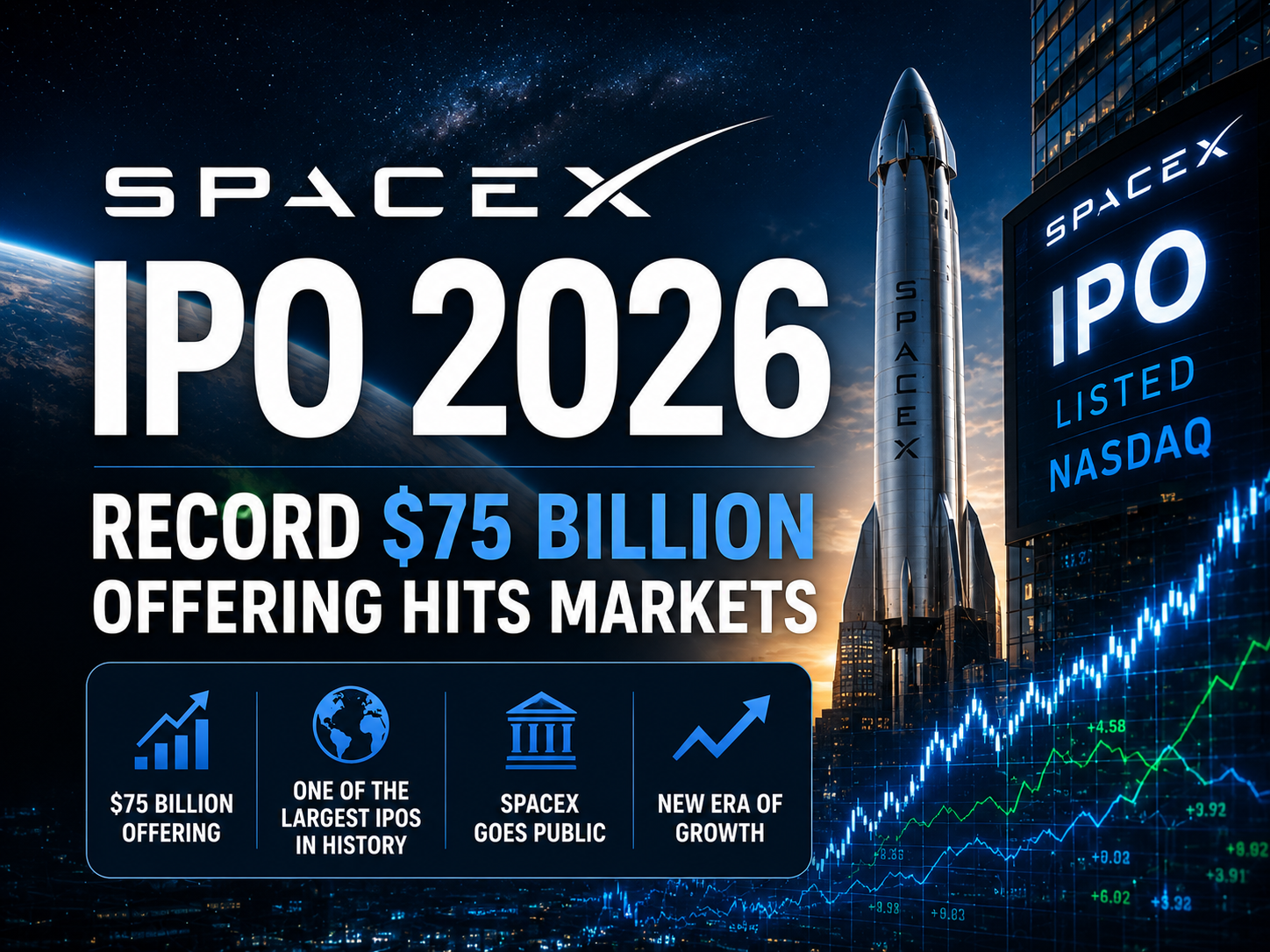
The SpaceX IPO 2026 is the most anticipated public offering in a generation. Elon Musk’s rocket launch, satellite communications, and artificial intelligence company plans to sell 555.6 million shares at $135 each, raising $75 billion in what would become the largest initial public offering in history, according to Reuters on June 3, 2026.
The deal targets a valuation of $1.75 trillion. If achieved, it would more than double the previous IPO record held by Saudi Aramco, which raised $29.4 billion in 2019. The company will list on the Nasdaq exchange under the ticker symbol SPCX.
SpaceX, known formally as Space Exploration Technologies Corp., filed its S-1 prospectus publicly in May 2026 after confidentially filing with the SEC in March. The offering is being led by Goldman Sachs, Morgan Stanley, Bank of America, Citigroup, JPMorgan Chase, and 18 additional underwriting banks.
The $135 Share Price and What It Means
Setting a fixed price before a roadshow is highly unusual in modern IPO practice. Companies typically announce a price range to gauge investor interest during presentations, then set a final price the day before trading begins. SpaceX has broken that convention entirely.
The decision to fix the price at $135 per share ahead of its formal marketing period signals confidence from Musk and his banking syndicate. It also reflects the extraordinary nature of this offering. There is no price discovery because, for SpaceX, the demand narrative precedes the numbers.
Global markets are watching closely. Reuters reported that SpaceX is considering allocating as much as 30% of the offering to retail investors, an unusually large retail tranche designed to tap into Musk’s enormous individual following. Shares will be available to retail investors through Robinhood ahead of the Nasdaq debut.
Global markets are moving. Finance decisions get made on real-time data, not yesterday’s headlines. 👉 Follow Daily Finance News at DF.Media (https://df.media/)
SpaceX Financials — Revenue, Losses, and Starlink
SpaceX generated $18.67 billion in revenue in 2025, up 43% year over year from $13.1 billion in 2024, according to Sacra research published in April 2026. Despite that growth, the company recorded a GAAP net loss of $4.94 billion in 2025, a sharp reversal from a profit of $791 million in 2024.
The loss is driven primarily by xAI-related capital expenditure. Out of nearly $21 billion in total capex spending in 2025, $12.7 billion went toward building out data centers for xAI, more than the company spent on rockets or satellites combined, according to ProfG Media analysis published May 2026.
Starlink remains the only consistently profitable segment. The satellite internet division generated $11.4 billion in revenue in 2025, representing 61% of total company sales, according to The Information. Starlink’s operating profit stood at $4.4 billion in 2025 on an adjusted EBITDA margin of approximately 63%. Subscriber growth has been equally impressive, with active users surpassing 10 million across 160 countries by February 2026, per SpaceX’s own reporting.
There is one headwind inside the Starlink numbers. Average revenue per user fell from approximately $99 per month in 2023 to around $66 per month in the first quarter of 2026, a compression of 33%, driven by cheaper international pricing tiers, according to Morningstar analysis published June 3, 2026.
At the targeted IPO price, SpaceX would trade at a trailing price-to-revenue multiple of approximately 93.7 times its 2025 revenue. For context, Palantir Technologies trades at around 81 times revenue, while Tesla trades at approximately 17 times, according to Reuters data.
The xAI Factor — Fuel or Fire Risk
In February 2026, SpaceX completed an all-stock acquisition of xAI, Elon Musk’s artificial intelligence startup and developer of the Grok chatbot. The deal valued SpaceX at $1 trillion and xAI at approximately $250 billion at the time of the transaction, per Bloomberg reporting.
xAI brought substantial compute infrastructure, including the Colossus data center, but it also brought substantial losses. xAI posted $6 billion in losses in 2025 and is projected to burn an additional $10 billion through 2026, according to BitMEX research published June 2026.
Morningstar equity analyst Nicolas Owens placed SpaceX’s fair value at $780 billion in a June 1, 2026 research note, less than half the IPO ask of $1.75 trillion. Owens specifically flagged xAI as posing a “material threat of value destruction,” noting that its competitive position against OpenAI and Anthropic leaves its economic moat indeterminate.
The bull case rests on a different thesis. SpaceX envisions a future in which AI workloads are processed inside orbital data centers powered by Starlink’s satellite backbone. Wedbush analysts refer to this as the “orbital intelligence” narrative. If that vision materializes, the 94x revenue multiple becomes a bet on an entirely new category of computing infrastructure.
What Investors and Traders Need to Know
SpaceX cannot be valued on a price-to-earnings basis because it reported a net loss in 2025. The cumulative GAAP deficit stands at $41.3 billion, a scale unprecedented among large IPOs, according to TradingKey analysis published June 2026.
The offering is all-primary, meaning all $75 billion in proceeds flow directly to the company rather than to existing shareholders. A 15% greenshoe option could push the total raise above $75 billion if demand warrants, according to Gotrade reporting.
Government revenue remains a critical line item. SpaceX generated $5.9 billion from US government contracts in 2025, including NASA, the Department of Defense, and intelligence agencies. Any shift in federal contracting priorities represents direct revenue risk, as detailed in the company’s S-1 filing.
“From a valuation perspective, it’s definitely not cheap,” said Fabien Yip, market analyst at IG International. “Investors are buying into hopes of the company’s exponential growth in the future given it’s not yet profitable.”
Vey-Sern Ling, managing director at Union Bancaire Privee, added: “It may be a stretch to achieve the valuation they want even with very generous multiples. But the current environment is supportive of all things tech-related and the market has always given Elon Musk the benefit of the doubt.”
Wall Street does not wait. Stay ahead of every IPO launch, market move, and rate decision that matters to your portfolio. 👉 Track Market Moves at DF.Media (https://df.media/)
What Comes Next — Roadshow, Pricing, and Debut
The formal investor roadshow begins June 4, 2026, with SpaceX executives meeting institutional investors across major financial centers. Final pricing is targeted for June 11, though Bloomberg noted the timeline could shift by a matter of days. Nasdaq debut under the ticker SPCX is expected on or around June 12, 2026.
The SpaceX listing is expected to trigger a broader wave of mega-cap technology IPOs. OpenAI and Anthropic are both reportedly advancing their own public offering plans. Alphabet revealed plans for an $80 billion equity offering on June 2, 2026. Together, SpaceX, OpenAI, and Anthropic are projected to add nearly $4 trillion in market capitalization to public markets, intensifying competition for institutional investor allocations, according to Reuters.
Starship Flight 12 is also scheduled for June 2026. Any successful heavy-lift mission would add momentum to the IPO narrative at a critical moment in the marketing cycle.
Key Takeaways
SpaceX is targeting a $75 billion IPO at $135 per share, which would make it the largest public offering in history, more than doubling Saudi Aramco’s $29.4 billion record from 2019. The company is seeking a $1.75 trillion valuation at 93.7 times its 2025 revenue of $18.67 billion. Starlink, the satellite internet division, is the only profitable segment, generating $11.4 billion in revenue and $4.4 billion in operating profit in 2025. xAI, folded into SpaceX in February 2026, is projected to burn $10 billion in 2026 and has driven the company to a $4.94 billion GAAP net loss. Morningstar has placed fair value at $780 billion, 55% below the IPO ask, citing execution risk and xAI’s uncertain competitive moat. The roadshow begins June 4, pricing targets June 11, and the SPCX Nasdaq debut is expected on or around June 12, 2026.
FAQ
Q: What is the SpaceX IPO price per share? A: SpaceX has set a fixed price of $135 per share for its initial public offering. The company plans to sell 555.6 million shares, raising $75 billion in total proceeds. This fixed pricing approach is highly unusual and breaks with standard IPO practice, where a price range is typically announced ahead of roadshows. (Source: Reuters, June 3, 2026.)
Q: What is SpaceX’s IPO valuation in 2026? A: SpaceX is targeting a valuation of $1.75 trillion at its IPO price of $135 per share. At that level, the company would trade at approximately 93.7 times its 2025 revenue of $18.67 billion. Morningstar has set a more conservative fair value estimate of $780 billion, anchored primarily to its Starlink and launch businesses. (Source: Morningstar, June 1, 2026.)
Q: When does SpaceX SPCX start trading on Nasdaq? A: SpaceX is expected to begin trading on the Nasdaq exchange under the ticker symbol SPCX on or around June 12, 2026. Final pricing is scheduled for June 11, following a formal investor roadshow that begins June 4, 2026. The timeline could shift by a few days depending on demand. (Source: Bloomberg, June 3, 2026.)
Q: Is SpaceX profitable? A: SpaceX is not profitable on a GAAP basis. The company reported a net loss of $4.94 billion in 2025, driven primarily by $12.7 billion in capital expenditure on xAI data centers. On an adjusted EBITDA basis, SpaceX posted $6.6 billion in 2025. Starlink, its satellite internet division, is the only segment generating consistent GAAP operating profit. (Source: S-1 filing via Sacra, April 2026.)
Q: What does SpaceX plan to do with IPO proceeds? A: SpaceX intends to use the $75 billion in proceeds to expand AI computing resources and its Starlink satellite network, according to its S-1 filing. The offering is entirely primary, meaning all proceeds flow to the company rather than to existing shareholders. A 15% greenshoe option could raise the total above $75 billion. (Source: Reuters, June 3, 2026.)
Q: How does the SpaceX IPO compare to Saudi Aramco? A: The SpaceX IPO would be the largest public offering in history at $75 billion, more than doubling the previous record of $29.4 billion set by Saudi Aramco in 2019. Unlike Aramco, which was profitable at the time of its listing, SpaceX is currently posting GAAP net losses while pursuing a long-term growth strategy in AI and space infrastructure. (Source: Reuters, June 3, 2026.)
“Before you decide whether to buy in, make sure you have read the 7 Shocking Facts About SPCX You Must Know — including the numbers most mainstream coverage is not highlighting.”
This article is for informational purposes only and does not constitute financial advice. Always conduct your own research before making any investment decisions.