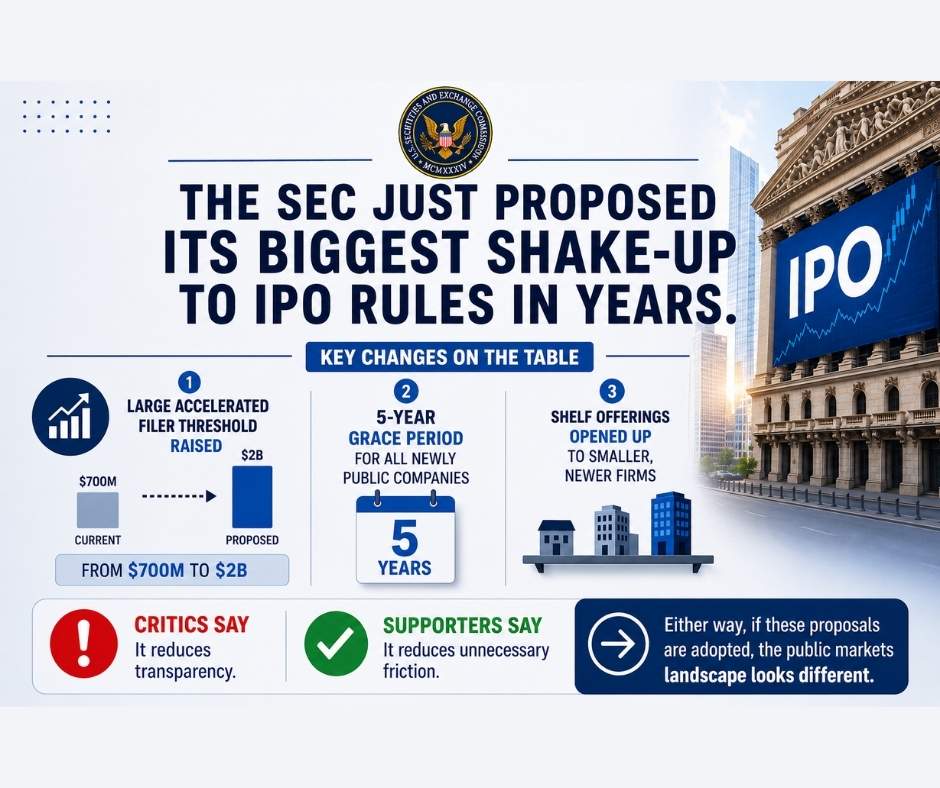
The U.S. Securities and Exchange Commission has unveiled a pair of broad regulatory reform proposals aimed at making it easier, faster, and cheaper for companies to go public a move that signals a significant shift in how Wall Street’s top regulator views the balance between investor protection and market participation.
Announced on Tuesday, May 19, the proposals target two key areas: the rules governing how companies register and issue shares, and the thresholds that determine how much financial scrutiny a public company faces. If adopted, the changes could reshape the IPO landscape at a time when public listings have been declining for years.
What Is the SEC Actually Proposing?
The center piece of the first proposal is a major overhaul of the “large accelerated filer” classification. Under current rules, any company with $700 million or more in publicly traded shares known as the public float is automatically classified as a large accelerated filer. This designation comes with strict obligations: tighter deadlines for annual and quarterly filings, and a requirement that independent auditors certify the quality of internal financial controls.
The SEC is now proposing to raise that threshold from $700 million to $2 billion. Even more notably, the proposal would give all newly public companies a five-year grace period before they can ever be classified as large accelerated filers, regardless of how quickly they grow. Companies would also be relieved of certain executive compensation disclosure requirements tied to shareholder advisory votes during this window.
SEC officials confirmed that under the proposed changes, roughly one in five currently listed companies would still meet the large accelerated filer bar — but that group would still represent approximately 90% of total U.S. market capitalization. In other words, the heavyweights stay heavily scrutinized while smaller and newer public companies get room to breathe.
Shelf Offerings Get a Makeover
The second proposal takes aim at shelf offerings — a mechanism that allows companies to pre-register securities with the SEC and then sell them later when market conditions are most favorable. It is a powerful tool for capital-raising flexibility, but currently limited to companies that already have at least $75 million in public float and have been filing with the SEC for at least one year.
The SEC is proposing to eliminate both of those requirements entirely, opening up shelf offerings to a much broader set of companies, including newly public ones. The change would give smaller firms the same tactical flexibility currently reserved for more established players.
There are carve-outs, however. The expanded rules would not apply to foreign private issuers, blank-check companies, penny stock firms, or shell companies categories that regulators say warrant separate scrutiny.
The Politics Behind the Proposals
These proposals don’t exist in a vacuum. They are part of the Trump administration’s broader financial deregulation agenda, and SEC Chair Paul Atkins has been vocal about wanting to create incentives for companies “to go and stay public.” The administration has argued that over-regulation is one reason the number of publicly listed U.S. companies has been shrinking for decades.
Industry groups have largely welcomed the move. The American Securities Association praised the announcement as a step toward revitalizing public markets.
But not everyone is cheering. Better Markets, a watchdog group that advocates for stronger Wall Street oversight, warned that the proposals would increase the risk of corporate misconduct by reducing transparency requirements. The group’s Ben Schiffrin also pointed to a deeper structural issue: public offerings have been declining not because of over-regulation, but because private markets have expanded to the point where companies can raise all the capital they need without ever going public. Loosening IPO rules, critics argue, doesn’t fix that underlying dynamic.
What This Means for the Market
If the proposals are finalized, the practical effects could be significant. More companies particularly mid-sized growth firms that have historically avoided the compliance costs of going public — may find the public markets more attractive. For investors, the influx of new listings could expand the opportunity set but also introduce more companies at earlier, less-scrutinized stages of their development.
The SEC has maintained that the changes will not compromise core investor protections, noting that the companies exempted from stricter requirements represent only a fraction of overall market value.
Both proposals will now enter a public comment period before any final rules can be adopted.
Frequently Asked Questions
1.What is a large accelerated filer?
A large accelerated filer is a publicly traded company with a public float of $700 million or more. These companies face the strictest SEC reporting timelines and must have independent auditors evaluate their internal financial controls. The SEC is proposing to raise this threshold to $2 billion.
2.How would the new rules affect newly public companies?
Under the proposed changes, all companies that go public would automatically receive a five-year grace period before being classified as large accelerated filers, regardless of how large their market value grows. This would ease compliance burdens during their early years as public companies.
3.What is a shelf offering and why does it matter?
A shelf offering allows a company to pre-register securities with the SEC and sell them later at a time of its choosing. It gives companies flexibility to raise capital quickly when market conditions are right. Currently, only companies with a $75 million public float and one year of SEC reporting history can use this tool. The SEC wants to remove both requirements.
4.Will these changes apply to all public companies?
No. The expanded shelf offering rules, for example, would not apply to foreign private issuers, blank-check companies, penny stock issuers, or shell companies. These categories are considered higher-risk and are being addressed through separate regulatory efforts.
Are investor protections being weakened?
The SEC says no, arguing that companies subject to reduced requirements represent a small fraction of total market capitalization. Critics, however, say that lighter disclosure rules reduce transparency and increase the risk of misconduct, particularly for smaller or newer companies.
Why are IPO numbers declining in the first place?
The decline in public listings has multiple causes. The growth of private equity and venture capital markets means companies can raise large sums without going public. Regulatory compliance costs have also been cited as a deterrent. The SEC’s proposals address the compliance side, though critics argue the deeper issue the attractiveness of private markets remains unresolved.