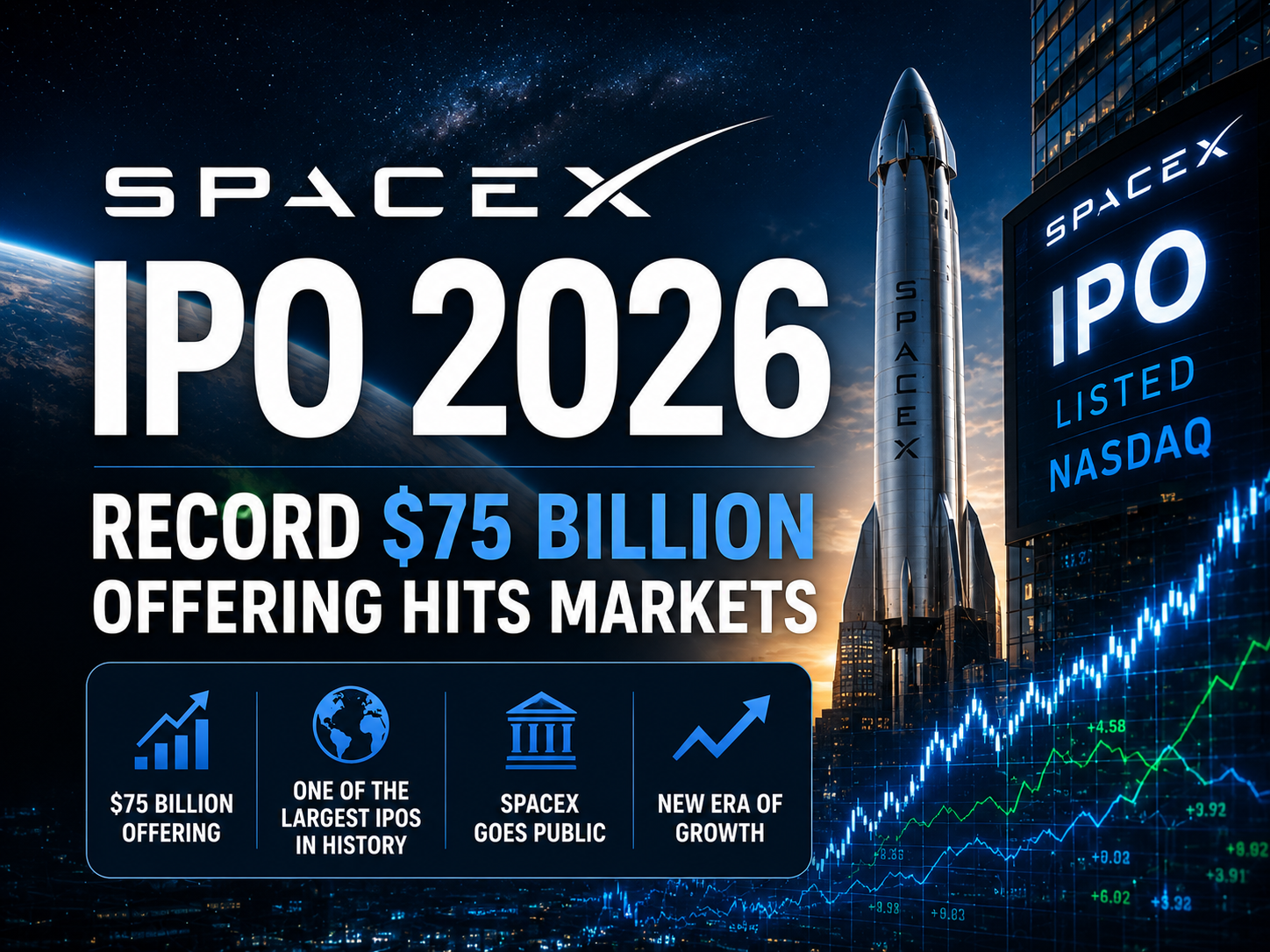
The SpaceX IPO is now the largest public offering in stock market history. On June 12, 2026, Elon Musk’s Space Exploration Technologies Corp raised a record $75 billion by selling 555.56 million Class A shares at $135 each on the Nasdaq under the ticker SPCX. By the closing bell, SPCX stock had surged 19% to $161.11 — and SpaceX’s market capitalization crossed $2 trillion on its very first day of trading.
The SpaceX IPO price made every prior record look modest. Alibaba’s 2014 IPO raised $25 billion. Saudi Aramco raised $29.4 billion. SpaceX did it at nearly three times that scale, with demand four times the shares available. Whether you are trying to understand the SpaceX valuation 2026 debate, figure out how to buy SpaceX stock today, or simply make sense of what a $2 trillion aerospace company means for the market — this is the complete guide.
When Did the SpaceX IPO Happen?
The SpaceX IPO priced on the evening of June 11, 2026, at $135 per share. Trading in SPCX stock began June 12 on the Nasdaq. The stock opened at $150, hit an intraday high of $176.52, and closed at $161.11 — a 19.3% gain from the SpaceX IPO price on day one. The offering eclipses every previous listing in history, including Alibaba ($25B, 2014) and Saudi Aramco ($29.4B, 2019).
As of June 13, SPCX stock carries a market capitalization of approximately $2.11 trillion, making SpaceX the sixth-largest publicly traded company in the United States overnight.
What Is the SpaceX IPO Price?
The SpaceX IPO price was set at $135 per share. The offering was four times oversubscribed — demand from institutional and retail investors far exceeded available shares. That pressure pushed SPCX stock to $161.11 on day one, giving the SpaceX IPO one of the strongest first-day performances for a listing of this size.
Investors buying SPCX stock in the open market today enter at roughly 19% above the SpaceX IPO price. That premium reflects the market’s opening verdict on SpaceX valuation 2026: the $1.75 trillion IPO price has already been surpassed in secondary trading.
What Is SpaceX Valuation 2026?
SpaceX valuation 2026 at the SpaceX IPO price was $1.75 trillion — the highest valuation ever assigned to a company at the moment of public listing. After SPCX stock‘s first-day rally, that figure expanded to approximately $2.11 trillion.
The SpaceX valuation 2026 debate is one of the most contested in finance. Morningstar analysts place fair value at $780 billion — less than half the SpaceX IPO price — citing the $4.9 billion GAAP net loss in 2025 and a price-to-sales multiple of approximately 100x. Scottish Mortgage Investment Trust had valued SpaceX at $1.25 trillion before listing, still 28% below where SPCX stock actually priced.
The bull case for SpaceX valuation 2026 centers on Starlink’s growth trajectory and a total addressable market of $28.5 trillion, weighted heavily toward AI infrastructure. Bears counter that capital-intensive aerospace businesses have never historically supported software-level multiples — regardless of how compelling the vision.
What Are SpaceX’s Financials?
SpaceX’s S-1 filing — the first public look at its finances — showed $18.7 billion in 2025 revenue and a net loss of $4.9 billion. Adjusted EBITDA reached $6.6 billion after stripping out capex, stock-based compensation, and xAI losses. In Q1 2026, revenue grew to $4.70 billion (up from $4.07B a year earlier), though the net loss widened to $4.30 billion, reflecting accelerated Starlink and Starship investment.
Starlink is the financial backbone of the SpaceX IPO story. The satellite internet segment generated $11.4 billion in 2025 revenue — 61% of total company revenue — serving 10.3 million subscribers in 164 countries with 9,600+ satellites deployed. According to CNBC, Starlink’s subscriber growth rate is the single most important variable in the SpaceX valuation 2026 equation.
How to Buy SpaceX Stock (SPCX) Today
Here is how to buy SpaceX stock right now: SPCX stock trades on the Nasdaq and is available through any brokerage with US equity access. US investors can buy SpaceX stock through Fidelity, Charles Schwab, Robinhood, E*Trade, SoFi, and eToro.
How to buy SpaceX stock internationally: most non-US brokerages that offer Nasdaq access list SPCX. No W-8BEN form is required for open-market purchases — that was only needed for SpaceX IPO allocation participants.
Before deciding how to buy SpaceX stock, consider the valuation context. At $161 per share, SPCX stock prices SpaceX at over 100x 2025 revenue. Financial advisors broadly recommend sizing any single IPO holding as part of a diversified portfolio, not a concentrated bet — especially for a company still recording multi-billion-dollar annual losses.
How Did Retail Investors Access the SpaceX IPO?
The SpaceX IPO reserved 30% of shares — more than $22 billion — for retail investors. That is three to six times the typical retail allocation in large US IPOs. Five brokerages distributed retail SpaceX IPO shares: Robinhood, SoFi, E*Trade, Fidelity, and Charles Schwab. Fidelity lowered its account minimum to $2,000 for SpaceX IPO participation. Retail investors who sold SPCX stock within 15 days may face restrictions on future Fidelity IPO allocations.
Is the SpaceX IPO Overvalued?
SpaceX valuation 2026 at $1.75 trillion — 100x revenue and rising — would be extreme by any traditional measure. Morningstar pegs fair value at $780 billion. The gap between their estimate and the SpaceX IPO price is not a rounding error; it reflects a fundamental disagreement about what kind of company SpaceX actually is.
The bear case on SPCX stock: SpaceX posted a $4.9 billion loss last year. Starship is unproven at commercial scale. Amazon’s Kuiper constellation is a credible Starlink competitor. At 100x sales, any subscriber growth miss makes the SpaceX IPO price look extended.
The bull case: Starlink’s $11.4 billion in 2025 revenue is compounding fast. The $28.5 trillion TAM reflects a genuine AI infrastructure shift. If Starlink hits 50 million subscribers and Starship routinizes launch costs, the SpaceX IPO price could look cheap in five years. SpaceX valuation 2026 is ultimately a bet on a decade-long trajectory, not a quarterly earnings play.
What Does the SpaceX IPO Mean for the Market?
The SpaceX IPO signals a new era for mega-cap technology listings. At $75 billion raised and a $2 trillion opening-day market cap, it recalibrates what “going public” means in 2026. Other privately held giants — Stripe, ByteDance, Databricks — face intensified investor pressure to follow given the SpaceX IPO‘s overwhelming success.
For the Nasdaq and US equity indices, SPCX stock‘s arrival at $2+ trillion creates immediate passive-fund rebalancing pressure. Index funds tracking large-cap growth will accumulate SPCX stock in the weeks ahead, creating sustained institutional buying beyond the IPO excitement.
SpaceX IPO: Key Facts at a Glance
IPO Date: June 12, 2026
Exchange: Nasdaq
Ticker: SPCX
SpaceX IPO Price: $135 per share
SPCX Stock Day 1 Close: $161.11 (+19.3%)
Day 1 Intraday High: $176.52
Shares Offered: 555.56 million Class A shares
Total Raised: $75 billion
SpaceX Valuation 2026 (IPO): $1.75 trillion
SpaceX Valuation 2026 (post day-one): ~$2.11 trillion
2025 Revenue: $18.7 billion
2025 Net Loss: $4.9 billion
2025 Adjusted EBITDA: $6.6 billion
Starlink Revenue (2025): $11.4 billion (61% of total)
Starlink Subscribers: 10.3 million in 164 countries
Retail Allocation: 30% of offering
How to Buy SpaceX Stock: Fidelity, Schwab, Robinhood, E*Trade, SoFi
Frequently Asked Questions — SpaceX IPO
What is the SpaceX IPO price?
The SpaceX IPO price was $135 per share. SPCX stock surged 19.3% on its first day of trading, closing at $161.11 on June 12, 2026.
When did SpaceX go public?
The SpaceX IPO priced June 11 and SPCX stock began trading June 12, 2026, on the Nasdaq. It raised $75 billion — the largest IPO in history.
What is SpaceX valuation 2026?
SpaceX valuation 2026 was $1.75 trillion at the SpaceX IPO price. After day one, SPCX stock pushed the market cap above $2.11 trillion.
How to buy SpaceX stock?
The SpaceX IPO debut came days after Wall Street absorbed major geopolitical shocks. For context on the broader market environment SPCX stock launched into, read our coverage: Stock Market Today: Dow Falls 953 Points as US Strikes Iran.
How to buy SpaceX stock: search SPCX on Fidelity, Schwab, Robinhood, E*Trade, or SoFi. The SpaceX IPO price was $135; SPCX stock now trades above $160 on the open market.
Is SpaceX profitable?
SpaceX is not GAAP profitable — it posted a $4.9 billion net loss on $18.7 billion in 2025 revenue. Adjusted EBITDA was $6.6 billion, and Starlink (61% of revenue) is growing rapidly.
Can I still buy SPCX stock after the SpaceX IPO?
Yes. The SpaceX IPO retail window has closed, but SPCX stock trades freely on the Nasdaq. Open any brokerage account and search SPCX — that is how to buy SpaceX stock today.
Stay Ahead of Every Major IPO with Daily Finance
The SpaceX IPO is the biggest story on Wall Street — but it will not be the last. From SPCX stock updates to the next trillion-dollar listing, Daily Finance covers every market-moving IPO, earnings event, and stock story in real time. Bookmark Daily Finance and stay one step ahead every trading day.