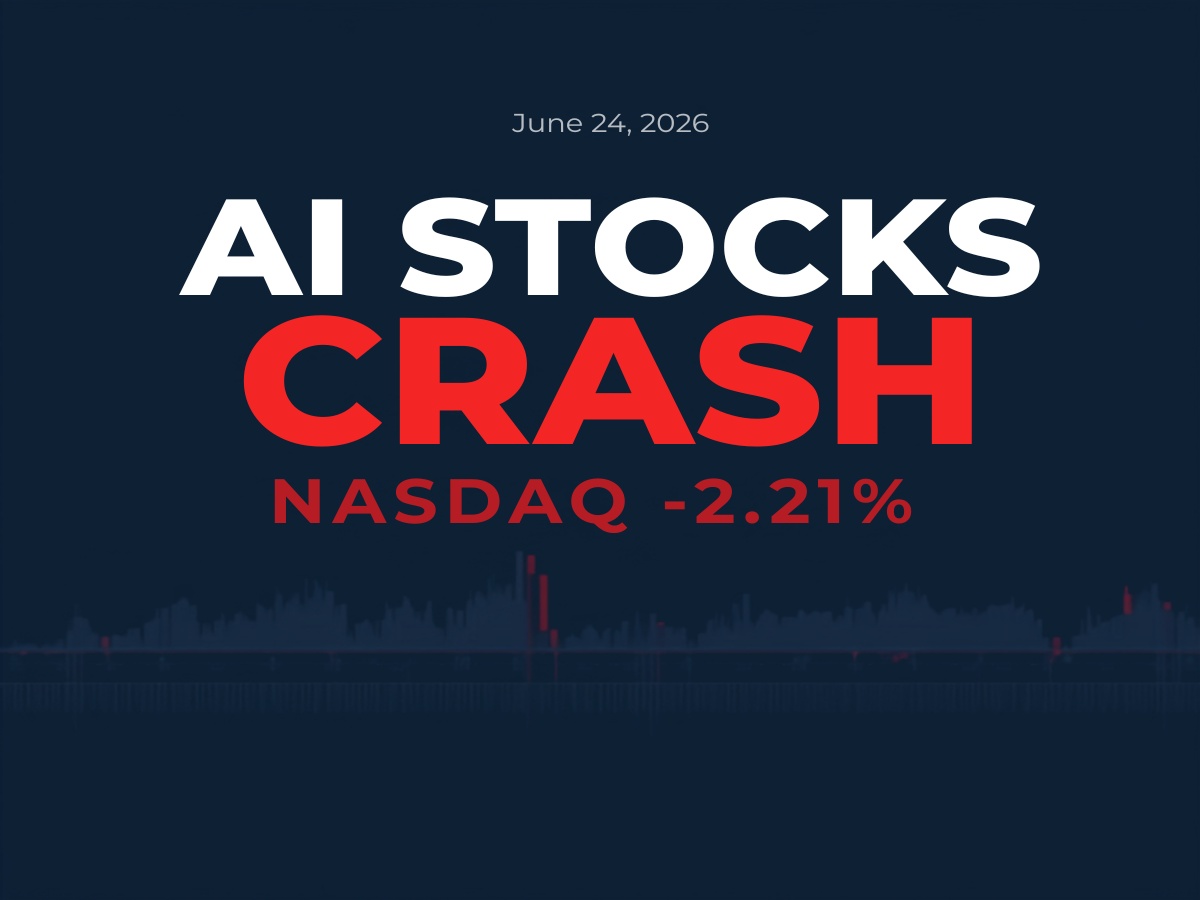
Markets today June 24, 2026 saw the Nasdaq Composite fall 2.21% to 25,587 and the S&P 500 drop 1.44% to 7,365 as a deepening AI stock selloff rattled Wall Street for a second consecutive session. Gold hit a two-week low at $4,067 per ounce, the US Dollar Index climbed to a new 2026 high above 101, and all eyes are on two major events: Micron Technology earnings after the close and Federal Reserve bank stress test results at 4:00 p.m. ET.
AI Selloff Deepens as Alphabet and Amazon Lead Tech Declines

The technology selloff accelerated on June 24 as Wall Street shifted from rewarding AI spending to demanding proof of returns. Combined 2026 capital expenditure across Microsoft, Alphabet, Amazon, and Meta has now exceeded $452 billion, a figure that is increasingly alarming institutional investors.
Alphabet (GOOGL) fell between 6% and 10% over two sessions after a high-profile AI talent exodus. John Jumper, a Nobel Prize-winning researcher and Google DeepMind lead, announced he is leaving for Anthropic. Noam Shazeer, co-lead of the Gemini AI model, departed for OpenAI. Alphabet’s Q1 2026 free cash flow fell 47% year over year to $10.12 billion. Amazon (AMZN) dropped 4% as its trailing twelve-month free cash flow collapsed 95% to $1.2 billion due to AI infrastructure costs. According to CNBC, Nvidia and other semiconductor names also declined as the broader AI trade unwound.
Micron Earnings June 24: The Biggest Test for Chip Stocks
Micron Technology (MU) reports Q3 fiscal 2026 earnings after the close on June 24. After tumbling 13% on Tuesday, Micron shares rebounded 4.1% in premarket trading as investors positioned ahead of the report. Analysts expect earnings of approximately $19.72 to $20.57 per share on revenue of $34.5 to $35.75 billion, representing year over year EPS growth of 932% and revenue growth of 271%. Micron guided fiscal Q3 to record revenue of $33.5 billion, gross margin of approximately 81%, and non-GAAP diluted EPS of $19.15. The company’s High Bandwidth Memory (HBM) capacity is sold out through the end of 2026, driven by demand from AI accelerator manufacturers including Nvidia.
Gold Price Today June 24: Falls to Two-Week Low as Dollar Surges
Spot gold fell 1% to $4,067.51 per ounce on June 24, its lowest level in nearly two weeks. Rising Federal Reserve rate hike expectations are strengthening the US dollar and reducing the appeal of gold, which pays no yield. The US Dollar Index rose to 101.65, a new 2026 high, as markets price an 87% probability of a Fed rate hike by December 2026. Goldman Sachs recently cut its year-end gold price target from $5,400 to $4,900, citing the hawkish Fed pivot. According to the International Energy Agency, falling crude oil prices may ease inflationary pressure and create room for a softer Fed stance later in the year.
Oil Prices June 24: Brent Crude Falls Below $72
Brent crude oil fell 1.76% to $71.92 per barrel on June 24, extending its sharp decline from recent highs above $82. The US-Iran diplomatic breakthrough last week reopened Strait of Hormuz shipments and returned additional supply to global markets. Lower energy costs are providing relief for consumers and businesses but weighing heavily on energy sector stocks. Oil is now down more than 12% from its June highs, representing one of the fastest crude price corrections of 2026.
Fed Stress Test 2026: Results for 32 Banks Released Today
The Federal Reserve releases its 2026 annual bank stress test results at 4:00 p.m. ET on June 24, evaluating 32 major US lenders including JPMorgan Chase, Goldman Sachs, and Bank of America. The stress scenario models unemployment rising to 10%, home prices falling 30%, and commercial real estate dropping 39%. The Fed confirmed results will not affect capital requirements until 2027 while it reviews its stress-testing methodology. According to the International Monetary Fund, US bank resilience is a critical pillar of global financial stability, making today’s results closely watched by international investors and central banks worldwide.
Dollar Index Hits 2026 High: Japanese Yen Faces Intervention Risk
The US Dollar Index crossing 101 for the first time in 2026 creates significant pressure across global markets. A stronger dollar weighs on commodities, emerging market currencies, and countries with dollar-denominated debt. The Japanese yen sits near 161 per dollar, its weakest level since the 1980s, with Japanese authorities repeatedly warning of potential intervention if yen weakness becomes disorderly. A move toward 163 to 165 could force the Bank of Japan to act within weeks.
Markets Today June 24: Full Scorecard
| Asset | Level | Change |
|---|---|---|
| S&P 500 | 7,365.46 | Down 1.44% |
| Nasdaq Composite | 25,587.04 | Down 2.21% |
| Dow Jones | 51,666.84 | Down 0.09% |
| Micron (MU) | Premarket plus 4.1% | After minus 13% Tuesday |
| Alphabet (GOOGL) | Down 6% to 10% | AI capex plus talent exodus |
| Gold (Spot) | $4,067.51 per ounce | Down 1.0% |
| Brent Crude | $71.92 per barrel | Down 1.76% |
| US Dollar Index | 101.65 | Plus 0.24% (2026 high) |
| USD/JPY | 161 | Yen at 1980s low |
What to Watch the Rest of June 24, 2026
Investors tracking markets today June 24 should focus on four key catalysts before the session ends. First, Micron Technology earnings after the close will set the tone for chip stocks and the broader AI hardware trade. Second, Federal Reserve stress test results at 4:00 p.m. ET will reveal how prepared major US banks are for a severe recession scenario. Third, May new home sales data will signal whether elevated mortgage rates are cooling housing demand. Fourth, the US Dollar Index holding above 101 could trigger further yen weakness and commodity selling.
Related Markets Coverage
For more context on the broader market trends shaping June 2026, read our coverage of Markets Today June 19: Nikkei Record High and Brent Crude at $79, the US Iran Talks Oil Prices Crash: 7 Market Shifts, and our analysis of how the US-Iran Peace Deal changed global markets in one morning.
Frequently Asked Questions: Markets Today June 24
What happened in markets today June 24, 2026?
Markets today June 24, 2026 saw the Nasdaq fall 2.21% to 25,587 and the S&P 500 drop 1.44% to 7,365 as the AI stock selloff deepened. Gold fell to a two-week low at $4,067 per ounce, the Dollar Index hit a new 2026 high above 101, and Brent crude fell to $71.92. The market is awaiting Micron earnings and Federal Reserve stress test results.
Why are AI stocks falling on June 24, 2026?
AI stocks are falling because investors question whether the over $452 billion in combined 2026 hyperscaler AI capital expenditure will generate sufficient returns. Alphabet lost key AI researchers to Anthropic and OpenAI, and free cash flow at major tech companies has declined sharply due to infrastructure spending. Wall Street is demanding proof of AI monetization before rewarding further spending.
What are analysts expecting from Micron earnings on June 24, 2026?
Analysts expect Micron to report Q3 fiscal 2026 earnings of approximately $19.72 to $20.57 per share on revenue of $34.5 to $35.75 billion, representing 932% year over year EPS growth. The critical metric is High Bandwidth Memory guidance, as Micron’s HBM capacity is fully sold out through the end of 2026 due to AI chip demand.
Why is gold falling on June 24, 2026?
Gold fell to $4,067 per ounce on June 24 because markets now price an 87% probability of a Federal Reserve rate hike by December 2026, strengthening the US dollar. The Dollar Index reached a new 2026 high above 101, making yield-free gold less attractive compared to dollar-denominated assets.
What are the Federal Reserve bank stress test results for 2026?
The Federal Reserve released its 2026 bank stress test results on June 24 at 4:00 p.m. ET, covering 32 major US banks including JPMorgan Chase, Goldman Sachs, and Bank of America. The scenario modeled unemployment rising to 10%, home prices falling 30%, and commercial real estate dropping 39%. Results will not affect capital requirements until 2027.
Markets Today June 24: What the Data Tells Us About the Rest of 2026
Markets today June 24, 2026 are sending three clear signals investors cannot ignore. First, the AI trade is maturing. The era of rewarding hyperscaler spending without evidence of returns is over. Wall Street now demands monetization — and until Alphabet, Amazon, and Microsoft can demonstrate that $452 billion in AI infrastructure spending translates into free cash flow growth, the risk premium on AI stocks will remain elevated.
Second, the Federal Reserve is firmly in control of the macro narrative. With an 87% probability of a December rate hike already priced in, and the Dollar Index at 2026 highs, the era of easy financial conditions that fuelled the AI rally is fading. Gold at $4,067 and Brent crude at $71.92 are both responding to this tightening signal.
Third, Micron Technology’s earnings tonight are a genuine inflection point. A beat-and-raise on HBM guidance could restore confidence in the semiconductor trade and arrest the two-day AI selloff. A miss or cautious guidance could extend the correction through the end of June and into July. The outcome of Micron’s earnings may well define the direction of markets today and for the weeks ahead.
Investors tracking markets today June 24 should resist overreacting to single-session moves. The underlying structural drivers — AI demand for HBM chips, the US-Iran diplomatic thaw lowering oil prices, and a resilient US banking system — remain intact. Volatility is creating entry points for disciplined investors, even as short-term sentiment turns cautious.
Stay ahead of global markets every day.
Breaking financial news, real-time data and expert analysis — all on Daily Finance.