August 10, 2026 | Finance | Global Markets
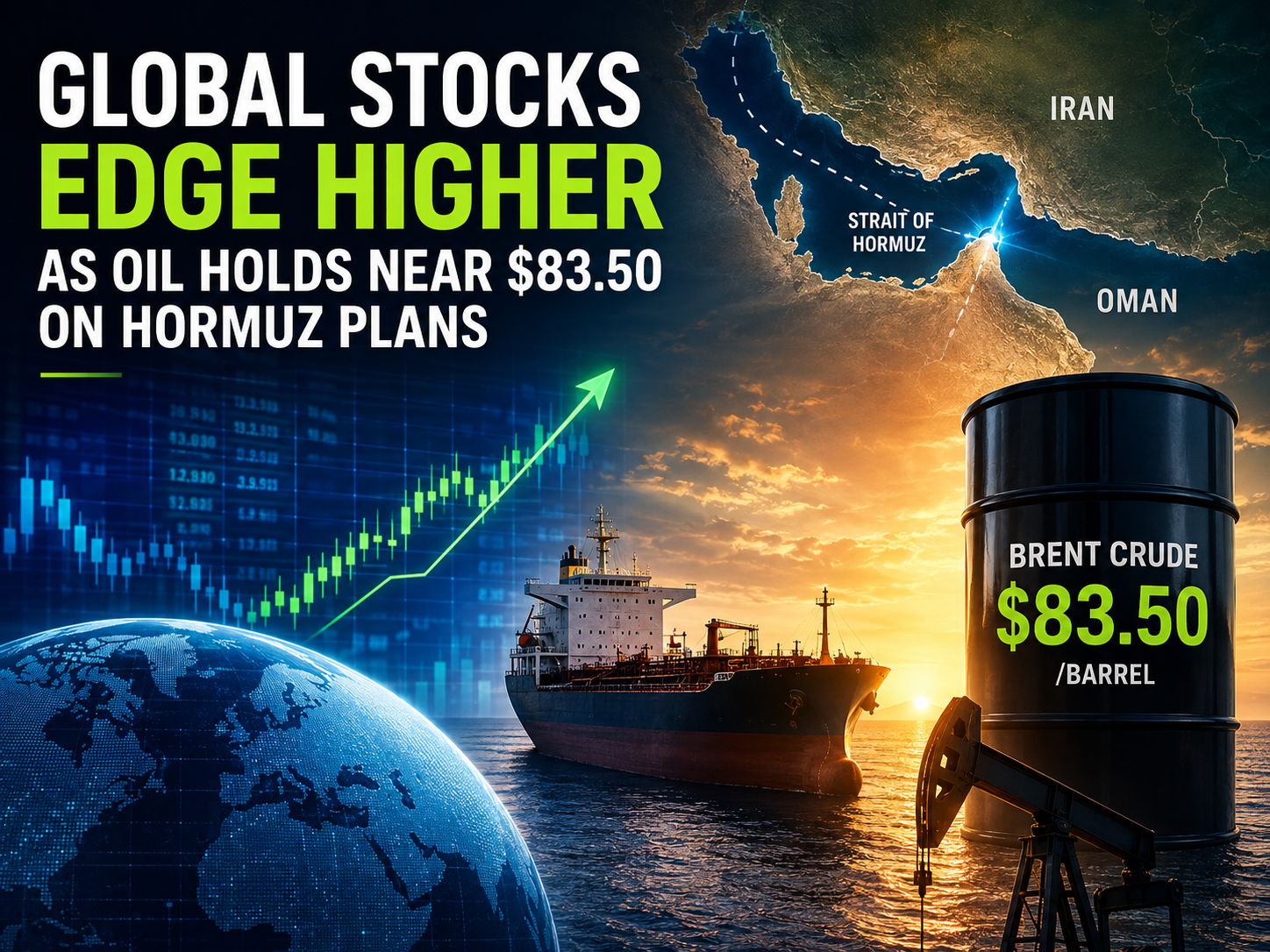
Global stocks edged higher Monday as investors weighed signs of progress on shipping arrangements through the Strait of Hormuz, steady crude oil prices and growing expectations that the Federal Reserve may keep interest rates unchanged this year.
The Stoxx 600 rose 0.1%, while S&P 500 futures gained 0.2% and Nasdaq futures advanced 0.4%. Asian markets were stronger, led by a 2.1% gain in Japan’s Nikkei 225.
Brent crude, meanwhile, was little changed near $83.50 a barrel, as investors monitored Iran’s discussions with Oman over new shipping lanes through the strategic waterway.
The next major catalyst for markets is Wednesday’s U.S. Consumer Price Index (CPI) report, which could influence expectations for the Federal Reserve’s September policy decision.
Global Stocks Rise as Investors Assess Fed and Oil Risks
Wall Street’s record-setting rally at the end of last week helped lift global equities into Monday’s session.
U.S. stocks finished at record highs Friday after a weaker-than-expected July jobs report caused investors to reduce expectations for additional Federal Reserve rate increases.
That shift has remained supportive for risk assets.
The MSCI global stock index was up about 0.1% Monday, while European shares posted modest gains.
Japan was the standout performer among major Asian markets, with the Nikkei climbing 2.1%. South Korea’s benchmark gained 0.7%.
The broader message from markets is straightforward: investors are increasingly betting that slowing economic momentum will limit the need for additional U.S. rate hikes.
Why Oil Prices Are Critical for Global Markets
Oil remains the biggest geopolitical variable for investors.
Brent crude was trading around $83.50 per barrel, well below its late-April peak above $126.
The latest development centers on the Strait of Hormuz, where Iran said talks with Oman over new transit arrangements were approaching a final agreement.
However, the situation remains unresolved. Iran has indicated that reopening the waterway fully would depend on additional conditions involving the United States.
That leaves energy markets highly sensitive to further announcements.
What Happens If the Strait of Hormuz Reopens?
A meaningful improvement in shipping through Hormuz could put downward pressure on oil prices by reducing fears of prolonged supply disruption.
Lower energy prices could also ease inflation pressures, particularly in the U.S. and other major economies that rely heavily on imported oil.
That would potentially give central banks more room to avoid additional interest-rate increases.
For investors, the Hormuz situation therefore matters beyond oil. It could influence inflation, bond yields, interest-rate expectations and stock valuations.
U.S. CPI Report Is the Week’s Biggest Market Test
The biggest scheduled economic event this week is the July U.S. CPI report, due Wednesday.
Economists surveyed by Reuters expect:
| U.S. Inflation Indicator | July Forecast | June |
|---|---|---|
| Headline CPI | 3.4% | 3.5% |
| Core CPI | 2.5% | 2.6% |
The expected moderation in inflation is helping reinforce expectations that the Federal Reserve may not need to raise rates again this year.
Fed futures currently imply roughly a 45% probability of a September rate hike, down sharply from about 67% one week ago.
Why Does CPI Matter for Stocks?
A cooler-than-expected CPI reading could strengthen expectations for a more accommodative Fed and potentially support stocks, particularly growth and technology companies.
A hotter CPI reading could have the opposite effect.
Higher-than-expected inflation would likely push Treasury yields higher and force investors to reconsider how quickly monetary policy can ease.
In short, Wednesday’s inflation report could determine whether the recent stock-market rally continues or loses momentum.
Strong Corporate Earnings Are Supporting the Rally
Economic data is only part of the story.
Corporate earnings have also helped push U.S. stocks toward record levels.
With roughly 90% of S&P 500 companies having reported results, analysts at Bank of America said earnings per share were approximately 30% higher year over year, excluding investment gains at Alphabet and Amazon.
The S&P 500 earnings beat rate was around 76%, matching its strongest level since 2021.
That earnings strength is giving investors another reason to remain bullish despite elevated valuations and geopolitical risks.
JPMorgan strategists have raised their 2026 S&P 500 earnings-per-share forecast to $365, representing projected annual growth of 35%.
The bank also increased its S&P 500 target to 8,000 from 7,800.
The index was recently around 7,758.
Treasury Yields Remain Closely Watched
The U.S. bond market was relatively quiet Monday.
The benchmark 10-year Treasury yield slipped one basis point to approximately 4.643% as investors prepared for roughly $125 billion in new Treasury issuance this week.
Bond yields remain particularly important for equity investors.
If inflation falls, yields could decline and improve the relative attractiveness of stocks. But persistent inflation could keep yields elevated, increasing pressure on high-growth companies whose valuations depend heavily on future earnings.
Dollar and Yen Face New Pressure
Currency markets were relatively stable, although the Japanese yen remained under scrutiny.
The euro was hovering near a seven-week high around $1.156, while the dollar gained 0.4% against the yen to approximately 158.48.
Investors remain alert to potential Japanese intervention as the yen weakens.
The Bank of Japan is also facing growing inflation concerns.
A summary of opinions from its July meeting showed policymakers discussing the possibility that rising inflation could require a faster pace of interest-rate increases.
That has increased expectations for a possible September Bank of Japan rate hike.
Three Things Investors Should Watch This Week
1. U.S. CPI
The inflation report is likely to be the biggest immediate catalyst for U.S. stocks, Treasury yields and the dollar.
2. Strait of Hormuz Developments
Any meaningful improvement in shipping could reduce the geopolitical premium in oil prices. A renewed disruption could send energy prices higher.
3. Corporate Earnings
Results from companies including Applied Materials, Cisco and CoreWeave will provide another test of whether strong corporate earnings can continue supporting elevated equity valuations.
What Does This Mean for the Stock Market?
The current market environment is being driven by three competing forces:
Bullish: Strong corporate earnings and reduced expectations for Fed rate hikes.
Neutral: Oil prices remain relatively contained despite geopolitical risks.
Risk: A hotter U.S. CPI reading or renewed disruption in the Strait of Hormuz could quickly change investor sentiment.
For now, investors appear willing to look through geopolitical uncertainty as long as oil prices remain controlled and corporate earnings remain strong.
But Wednesday’s inflation report could provide the market with its next major direction signal.
Frequently Asked Questions
Why are global stocks rising today?
Global stocks are edging higher as investors respond to strong corporate earnings, reduced expectations for additional Federal Reserve rate hikes and developments around shipping through the Strait of Hormuz.
What is happening with oil prices?
Brent crude is trading near $83.50 a barrel as investors monitor Iran’s discussions with Oman regarding shipping arrangements through the Strait of Hormuz.
Why is the Strait of Hormuz important to financial markets?
The Strait of Hormuz is a major global energy transit route. Prolonged disruption could push oil prices higher, increasing inflation and potentially affecting interest-rate expectations and stock valuations.
What will move U.S. stocks this week?
The July U.S. CPI report on Wednesday is likely to be the most important scheduled economic event. Corporate earnings and developments around Hormuz are also important market drivers.
Is the Federal Reserve expected to raise rates in September?
Market pricing currently implies roughly a 45% probability of a September rate hike, down from about 67% a week earlier. The CPI report could significantly change those expectations.
📌 Stay ahead of markets, business and financial news with DF Media.
Visit DF Media for the latest finance and business news →