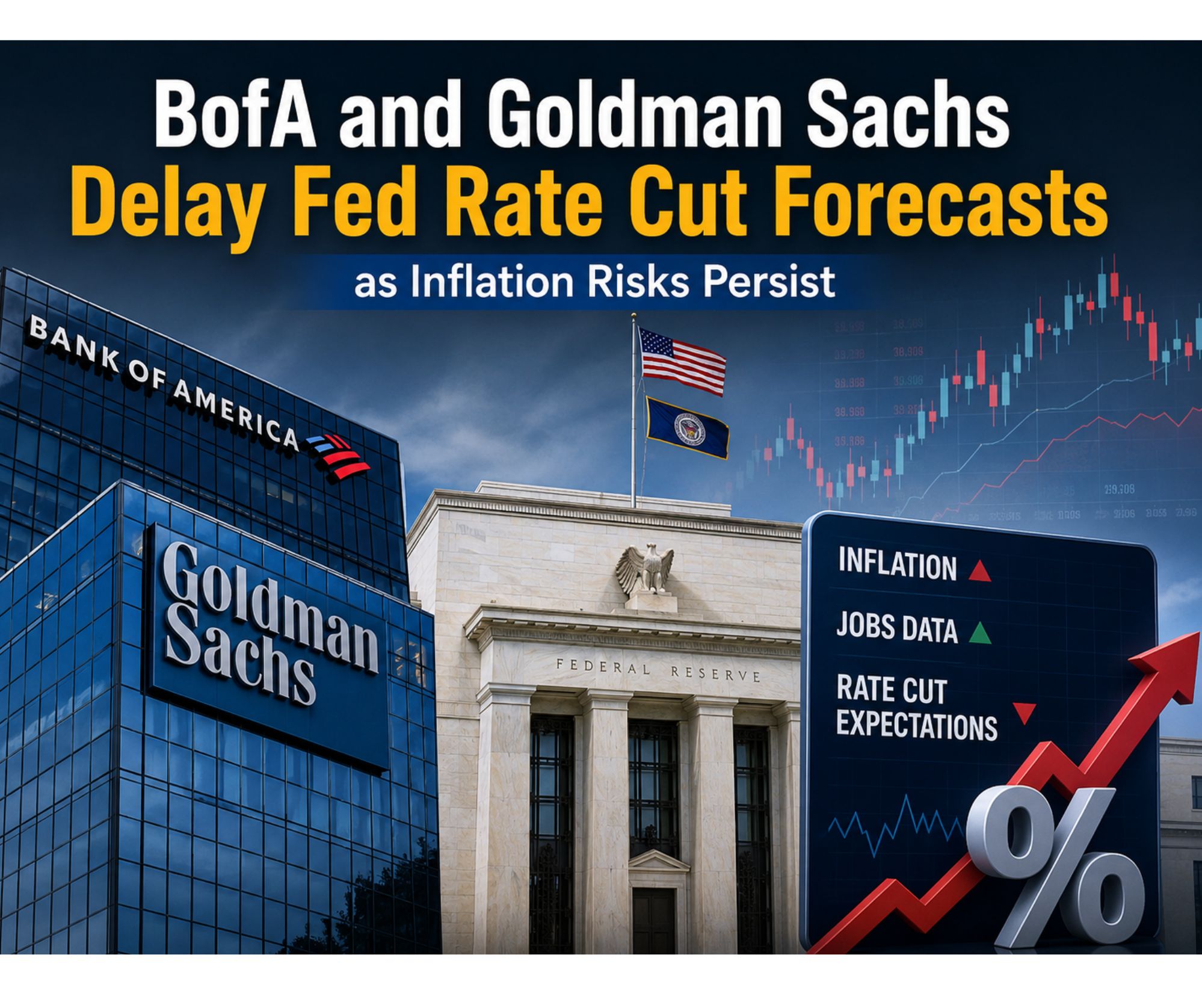
Wall Street firms are rapidly pushing back expectations for U.S. Federal Reserve interest rate cuts as stubborn inflation, rising energy prices, and resilient labor market data complicate the central bank’s path toward monetary easing.
Bank of America and Goldman Sachs are among the latest major financial institutions to revise their forecasts, signaling that interest rates could remain elevated much longer than markets previously anticipated.
BofA Global Research now expects the Federal Reserve to hold rates steady throughout 2026, projecting two quarter-point cuts only in July and September 2027. Goldman Sachs also delayed its outlook, forecasting rate cuts in December 2026 and March 2027, compared with its earlier expectation for the first cut in September this year.
The revised projections reflect mounting concern across financial markets that inflationary pressures remain too strong for the Fed to begin easing policy anytime soon.
The shift comes as the ongoing conflict in the Middle East continues to drive higher oil and energy prices, increasing fears that inflation could remain sticky across key sectors of the U.S. economy. Policymakers have become increasingly cautious about lowering borrowing costs prematurely while inflation still sits well above the Federal Reserve’s long-term 2% target.
Recent economic data has further reinforced the higher-for-longer narrative. U.S. employment growth exceeded forecasts in April, while the unemployment rate held steady at 4.3%, underscoring continued strength in the labor market despite elevated interest rates.
Analysts at Goldman Sachs said the Federal Open Market Committee may ultimately delay easing further if labor market conditions remain resilient through the second half of the year. The bank noted that insufficient economic slowdown could push the final phase of rate cuts into 2027.
The Federal Reserve’s April policy meeting highlighted growing divisions within the central bank itself. Officials voted 8-4 to keep interest rates unchanged, marking one of the closest Fed decisions in decades and signaling heightened uncertainty over the inflation outlook.
Markets are now increasingly pricing in the possibility that rates could remain within the current 3.50% to 3.75% range through the end of 2026.
The changing outlook is already reshaping investor sentiment across global markets. Treasury yields have remained elevated, while growth-oriented equities and technology stocks continue to face pressure from tighter financial conditions. Startups and high-growth companies are also confronting more difficult funding environments as access to low-cost capital becomes increasingly limited.
Meanwhile, a stronger U.S. dollar driven by expectations of prolonged higher rates is adding pressure on emerging markets and global investment flows.
BofA analysts said incoming Federal Reserve Chair Kevin Warsh may favor lower rates over time, but current economic conditions and inflation trends leave little room for immediate policy easing.
For investors, businesses, and policymakers, the latest revisions from Wall Street reinforce a growing consensus that the Federal Reserve’s fight against inflation is far from over.