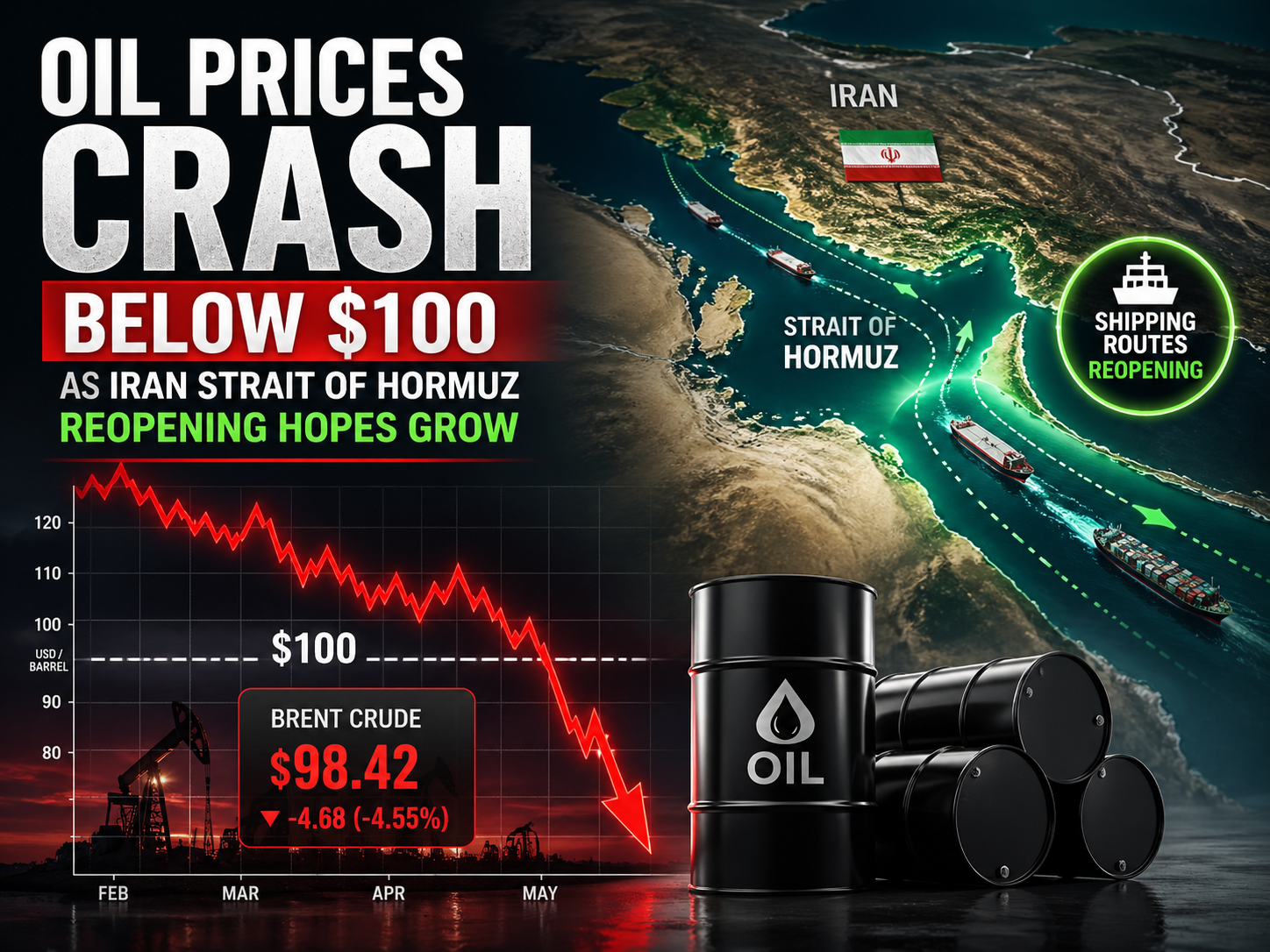
Brent crude dropped nearly 11% on May 6, 2026, falling below $98 a barrel after Iran’s Islamic Revolutionary Guard Corps navy signalled that the strait of Hormuz could reopen. The announcement, coupled with reports of progress in US-Iran peace talks, triggered one of the sharpest single-day selloffs in energy markets in recent memory.
What Happened to Oil Prices Today?
Oil markets experienced a dramatic reversal on Wednesday as hopes of a geopolitical breakthrough sent traders rushing to unwind their positions. Brent crude slid to $97.48 a barrel, shedding more than $12 on the day and hitting its lowest level since April 22. US West Texas Intermediate crude fell 11.3% to $90.74 a barrel. The selloff extended across European gas markets, with the Dutch front-month benchmark contract dropping nearly 12% intraday before recovering to trade down 8.6% at €42.91 per megawatt hour. The British June gas contract fell 8.5% to 105.15p per therm.
The catalyst was a series of statements from Iran’s Islamic Revolutionary Guard Corps navy. In posts on social media in both Persian and English, the IRGC announced that the strait of Hormuz could reopen following what it described as the neutralisation of threats from aggressors. The IRGC thanked captains and shipowners across the Gulf for complying with Iran’s strait regulations and contributing to regional maritime security, stating that safe and stable passage would be ensured under new protocols.
Adding further momentum to the selloff, Reuters reported — citing a Pakistani source — that the United States and Iran are moving closer to an initial peace deal. No further details about the scope or terms of any agreement emerged during trading hours, but the signal alone was enough to send energy prices sharply lower.
Why the Strait of Hormuz Matters So Much
To understand the scale of Wednesday’s market reaction, it helps to appreciate just how critical the strait of Hormuz is to global energy supply. The waterway is one of the world’s most strategically important shipping chokepoints, connecting the Persian Gulf to the Gulf of Oman and the broader international market. Roughly 20% of the world’s daily oil supply passes through it, making any disruption to traffic through the strait an immediate shock to global prices.
The recent period of elevated tensions had already pushed Brent crude well above $100 a barrel, as markets priced in the risk of prolonged supply constraints. Wednesday’s moves reflected an equally sharp repricing in the other direction — markets quickly adjusting to the possibility that those constraints could ease significantly faster than anticipated.
Caution Remains Despite the Rally
Not everyone is convinced the selloff reflects the full picture. David Morrison, senior market analyst at Trade Nation, described Wednesday’s moves as a wave of risk-on trading as investors added a peace dividend across the board. But Morrison was quick to add a note of caution: no concrete details have emerged about what any potential deal might include, and even if the strait reopens fully, normalisation in shipping and trade flows would take months, not days.
That caution is well-founded. Oil inventories are not critically low, but uneven distribution and declining buffers in key consuming regions continue to raise concerns about localised shortages. A reopening of the strait eases the headline risk significantly, but it does not immediately resolve the logistical and infrastructure challenges that have built up over a prolonged period of restricted access.
There is also the question of geopolitical durability. Markets have seen false dawns before in the US-Iran relationship, and a Pakistani-sourced report of progress in peace talks, while significant, falls well short of a signed agreement. Traders who locked in gains on Wednesday will be watching closely for any signs that the diplomatic momentum stalls.
What to Watch Next
The key variables in the coming days are straightforward. First, any official confirmation from either the US or Iranian government about the status of peace negotiations would either validate or deflate Wednesday’s repricing. Second, shipping data from the strait itself will matter — actual vessel movements resuming at pre-tension levels would provide concrete evidence that supply is flowing freely again. Third, OPEC responses bear watching: a sustained fall in prices below $95 could prompt member states to revisit output decisions made when prices were considerably higher.
For now, energy markets are operating on hope rather than certainty. The direction of travel is clear, but the road ahead remains uncertain.
Frequently Asked Questions
1.Why did oil prices fall so sharply on May 6, 2026?
Oil prices fell nearly 11% after Iran’s IRGC navy announced that the strait of Hormuz could reopen following the end of what it called threats from aggressors. Reports from Reuters citing a Pakistani source also indicated the US and Iran are moving closer to a peace deal, compounding the selloff as markets priced in a significant easing of supply constraints.
2.What is the strait of Hormuz and why do oil markets care about it?
The strait of Hormuz is a narrow waterway connecting the Persian Gulf to the Gulf of Oman. Approximately 20% of the world’s daily oil supply passes through it, making it one of the most critical chokepoints in global energy trade. Any threat to traffic through the strait — whether from military tensions, blockades, or conflict immediately pushes oil prices higher, while signs of reopening push them lower.
3.What did the IRGC actually announce?
Iran’s Islamic Revolutionary Guard Corps navy posted statements in both Persian and English on social media, saying the strait of Hormuz could reopen now that threats from aggressors had been neutralised. The IRGC thanked Gulf shipping operators for complying with Iran’s maritime regulations and stated that safe passage would be guaranteed under new protocols.
4.Will oil prices continue to fall if the strait reopens?
Not necessarily straightaway. Even if the strait fully reopens, analysts including David Morrison of Trade Nation caution that normalisation in shipping and trade flows could take months. Oil inventories remain unevenly distributed, and no confirmed peace agreement has been signed. Prices could stabilise or recover partially depending on whether diplomatic progress holds and OPEC adjusts its output targets in response.
5.How low could Brent crude go?
That depends heavily on whether the US-Iran peace process produces a concrete agreement and whether the strait reopens fully and sustainably. If both happen, analysts expect continued downward pressure. However, OPEC member states are likely to respond if Brent falls significantly below $95 a barrel, providing a floor through potential output cuts. source
Stay ahead of the latest developments in global markets and financial news. Visit Daily Finance for in-depth coverage, analysis, and breaking stories.